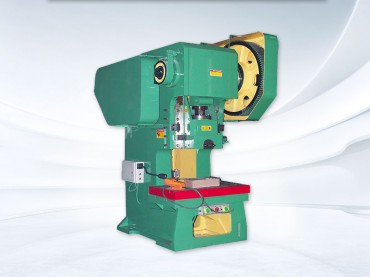
In the metalworking industry, stamping is a very common metal forming process. Automotive parts, home appliance housings, hardware products, electronic components, and various structural metal parts can all be produced using stamping equipment. Among the various types of stamping equipment, the mechanical press is one of the most widely used.
Mechanical presses use a mechanical transmission system to convert the rotary motion generated by an electric motor into the reciprocating linear motion of a slide. Pressure is then applied to the metal sheet via a punch and die set, causing the material to undergo shearing, punching, bending, deep drawing, or other forms of plastic deformation to achieve the desired part shape.
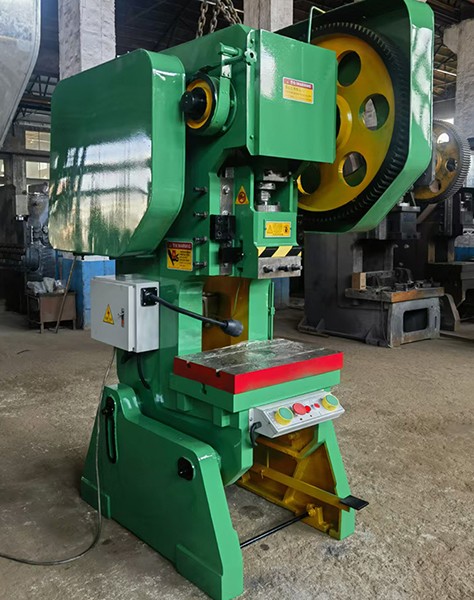
A mechanical press is a machine that uses a mechanical transmission mechanism to generate pressure for forming metal sheets or other suitable materials. It typically consists of a machine frame, bolster (or work table), slide, transmission mechanism, electric motor, flywheel, crankshaft, connecting rod, and stamping die.
During operation, the electric motor first drives the flywheel to rotate. The flywheel stores and releases mechanical energy, transmitting power to the crankshaft via a clutch or similar mechanism. As the crankshaft rotates, the connecting rod drives the slide in an up-and-down reciprocating motion. The punch is usually mounted on the slide, while the die is mounted on the bolster. When the slide moves downward, the punch approaches and acts upon the metal sheet placed on the die, causing the material to deform or separate according to the die design. A complete mechanical stamping cycle concludes when the slide finishes the stamping action and returns to its upward position.
The working process of a mechanical press can be simply summarized as follows: Electric Motor → Flywheel → Clutch → Crankshaft → Connecting Rod → Slide → Punch → Workpiece.
First, the electric motor starts and drives the flywheel to rotate. Due to its high moment of inertia, the flywheel stores mechanical energy. When a stamping operation is required, the clutch transmits power from the flywheel to the crankshaft. The crankshaft begins to rotate and, via the connecting rod, converts this rotary motion into the vertical movement of the slide. The slide drives the punch downward, applying pressure to the workpiece. Depending on the installed die, the punch can perform various operations such as punching, blanking, bending, forming, and deep drawing. Afterward, the slide returns to its top dead center position, completing one processing cycle.
Therefore, the core operational process of a mechanical press involves using a mechanical transmission system to convert continuous rotary motion into periodic linear stamping motion.
Punching is a very common operation for mechanical presses. Before processing begins, the metal sheet is placed in the die's working area, and the die is properly positioned. As the slide moves downward, the punch mounted on it enters the die cavity.
Due to the precise clearance between the punch and the die, the sheet undergoes localized shear deformation and eventually separates under the punching force, creating a hole. Once the slide retracts, the punching operation is complete. Punching offers high speed and excellent repeatability, making it ideal for the mass production of metal parts requiring numerous holes.
- Automotive manufacturing is a major application area for mechanical stamping equipment; vehicle bodies and various components incorporate a large number of stamped parts.
- Home appliance manufacturing also relies on stamping processes. For instance, metal structural components for refrigerators, washing machines, air conditioners, and other appliances can be produced using stamping techniques.
- The hardware manufacturing industry is another significant market for mechanical presses. Products such as door and window fittings, metal brackets, connectors, and decorative elements are often manufactured via stamping.
Additionally, sectors such as electronics, electrical equipment, construction, transportation equipment, and general machinery manufacturing utilize mechanical presses depending on product design requirements.
High production efficiency is a key reason for the widespread use of mechanical presses in manufacturing. Once the die is designed and installed, the machine can operate continuously with a fixed stroke and speed. For large quantities of identical metal parts, mechanical stamping reduces the processing time per unit and enhances product consistency.
Automation levels can be further increased by integrating automatic feeders, robotic arms, and production line control systems. Consequently, mechanical presses typically deliver high efficiency in the mass production of metal parts.
Improving the production efficiency of mechanical presses typically requires optimization across several areas: equipment, tooling, and production processes.
First, automatic feeding systems can be used to reduce the time spent on manual loading and unloading.
Second, multi-station dies can be employed to complete multiple processing steps within a single stamping cycle.
Third, stamping speed and stroke settings can be optimized based on material characteristics.
In addition, regular maintenance of the mechanical press is crucial. Components such as the lubrication system, clutch, brake, crankshaft, and guide elements must be inspected according to equipment specifications. Stable and efficient production can only be achieved when the equipment, tooling, materials, and production processes are well-matched.
Mechanical presses are industrial machines that generate significant mechanical energy; therefore, safe operation is paramount. Operators must undergo professional training and be familiar with operating procedures and safety devices. Before production begins, components such as dies, fasteners, the lubrication system, the clutch, and the braking system should be checked for proper functioning. During operation, hands or other body parts must not be placed within the danger zone of the die.
For automated production lines, it is also essential to ensure that safety guards, photoelectric protection devices, and other interlocking systems are functioning correctly.
If the equipment produces abnormal noise or vibration, or experiences other malfunctions, it should be stopped immediately so that trained personnel can conduct inspections and repairs.
Safe operation not only protects personnel but also helps minimize equipment damage and production downtime.
When selecting a mechanical press, it is necessary to first clarify the product and process requirements. Nominal force is a key parameter; the equipment's rated force must meet the actual demands of the stamping process. Next, factors such as maximum material thickness, workpiece dimensions, die size, and required stamping speed must be considered. Additionally, attention should be paid to the slide stroke, shut height, bolster size, equipment rigidity, and automation configuration.
If the primary output consists of small hardware parts, the focus might be on production speed and feeding efficiency; conversely, if producing large structural components, the focus might shift to equipment rigidity, bolster size, and force capacity. Consequently, no single mechanical press is suitable for every production task. A sound equipment choice should be based on the specific product, materials, and stamping process involved.
In general, the operating principle of a mechanical press involves using a mechanical transmission system to convert the rotary motion generated by an electric motor into the reciprocating linear motion of a slide; pressure is then applied to metal materials via a punch and die to perform operations such as punching, blanking, bending, deep drawing, and forming.
As manufacturing becomes increasingly automated and intelligent, mechanical presses are being integrated with automatic feeding systems, robotics, rapid die-change mechanisms, and intelligent monitoring systems. Looking ahead, mechanical presses will continue to play a vital role in metal forming and mass parts manufacturing, with proper equipment selection, die design, process parameter optimization, and safety management serving as the essential foundations for stable stamping production.
 Address:Room 1202, Detaitang Building, No. 118 Huaguang Road, Zhangdian District, Zibo, Shandong
 WhatsApp:+8615653328535
 Wechat: +8615965331535
  E-mail:zs@sdsmachinery.com