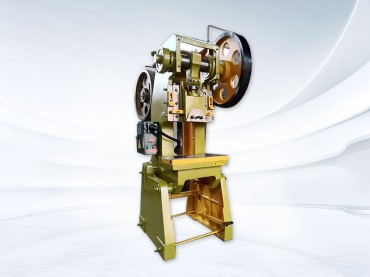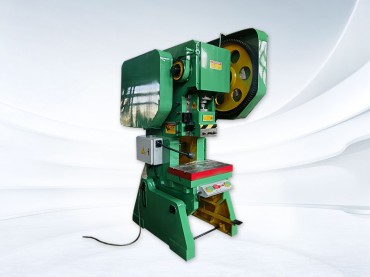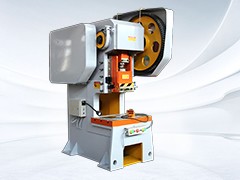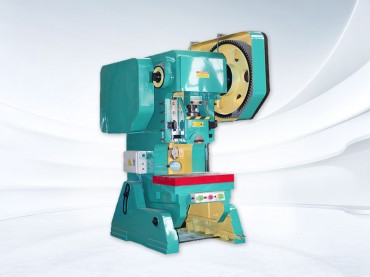
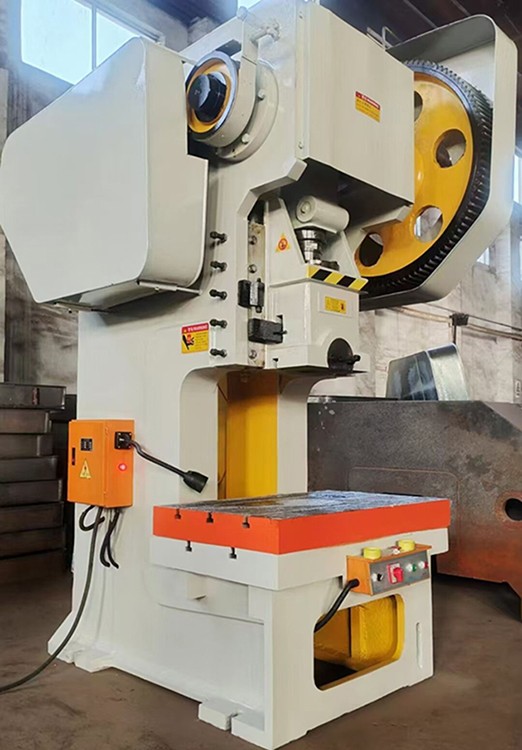
The core mechanism of a mechanical press is based on a crank-slider mechanism. The electric motor drives the flywheel to rotate through a belt or gear, and the flywheel stores kinetic energy and connects to the crankshaft through a clutch. When the clutch is engaged, the crankshaft begins to rotate, driving a connecting rod that moves the slider up and down. When the slider moves downward, the mold mounted on the slider cooperates with the lower mold fixed on the table to process the material placed therein, such as punching, bending and stretching. After completion, the slide moves upward and the workpiece is removed or automatically discharged. The whole process relies on the precise coordination of the mechanical structure to ensure efficient and stable output.
(1) High speed and high precision: the processing speed of mechanical press can reach more than 400 times per minute, and the processing precision is high, which can meet the needs of various metal processing.
(2) Low noise: compared with other types of presses, mechanical presses produce relatively low noise during operation. Under the condition of reasonable installation and good lubrication, the mechanical press can ensure a
relatively quiet environment in the workshop.
(3) Simple operation: the operation interface of the mechanical press is intuitive, and the startup, shutdown and adjustment are relatively simple, even for non-highly skilled workers, they can master the operation after basi
training. This has a positive effect on small and medium-sized enterprises to reduce labor training costs, and quickly put into production.
(4) Low cost: Compared with CNC presses, the cost of mechanical presses is relatively low, which can meet the metal processing needs of small and medium-sized enterprises.
(1) Safety and danger: there are certain safety hazards in mechanical presses, and if they are not operated properly, they are very likely to cause accidents.
(2) Easy to wear and tear: the punch of mechanical press is easy to wear and tear, and needs to be replaced regularly.
(3) Difficult to maintain: the maintenance of mechanical presses requires a high level of skill and is difficult to repair and maintain.
(4) Manufacturing accuracy is affected: since the mechanical press is driven by mechanical force, it will be affected by many factors in the working process, and when there is a big change in the working medium, the manufacturing accuracy of the press will be greatly affected.
(5) Prone to jamming phenomenon: when the processing process encounters very hard materials, or when there is an overload situation, the mechanical press is prone to jamming phenomenon, affecting the processing efficiency.
Because of its high efficiency and strong adaptability, mechanical press is widely used in all kinds of metal processing fields, mainly including:
is used for blanking and forming of body coverings, brackets, reinforcing plates and so on, which can satisfy the demand of high mass production.
refrigerator, washing machine, air conditioning and other products shell and structural parts commonly used mechanical press processing, to ensure the surface quality and assembly precision.
Mechanical presses are still the main equipment for parts requiring batch production and high precision, such as cell phone shells, computer accessories and tool hardware.
Building structural parts, metal decorative plates, etc. are often molded by mechanical presses.
kitchenware, lamp parts, bicycle parts and other small metal products rely heavily on mechanical presses for stamping production.
Safety and maintenance are the key links for the long-term stable operation of mechanical punching machines.
-Operators need to be trained and strictly observe the operation specification;
-The bed must be installed with stopping devices and guards (e.g. photoelectric protector, two-handed push-button control);
-It is strictly prohibited to reach out and take parts directly in the stamping area, and a robot or fixture should be used.
-Maintenance: regular inspection and lubrication oil to reduce the shaft, connection wear.
-Strict Inspection: Regularly check whether the bolts and studs are rotating to avoid equipment damage due to vibration;
-Mold Maintenance: Repair grinding or replace the worn out molds to ensure the quality of products;
-Electrical system: check the electrical wiring and control system to prevent malfunction due to poor contact;
-Periodic overhaul: It is recommended to carry out a comprehensive overhaul every six months to ensure that the equipment is in good condition.
As a traditional and efficient metal processing equipment, mechanical press still occupies an important position in the global manufacturing industry by virtue of its high speed, high precision and low cost. However, there are safety risks associated with mechanical presses, and enterprises should strengthen safety measures and improve maintenance levels to realize the safe and efficient operation of the equipment in the process of using them.
If you are interested in Mechanical Punching Machines, please contact us, we will recommend the right machine and quote for you.
 Address:Room 1202, Detaitang Building, No. 118 Huaguang Road, Zhangdian District, Zibo, Shandong
 WhatsApp:+8615653328535
 Wechat: +8615965331535
  E-mail:zs@sdsmachinery.com