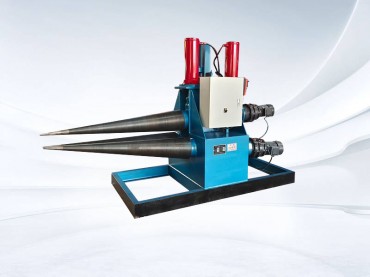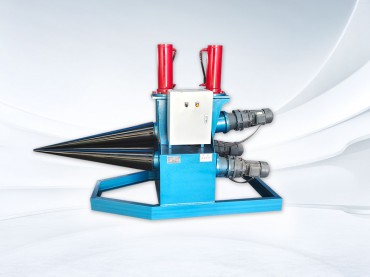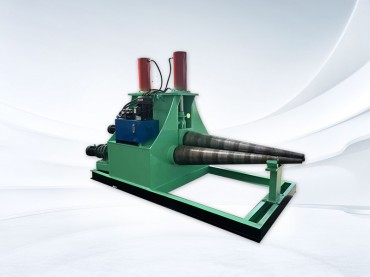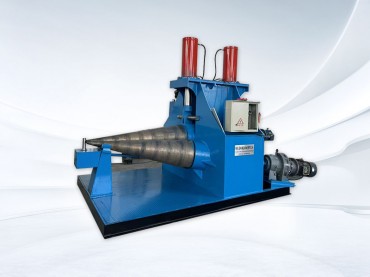
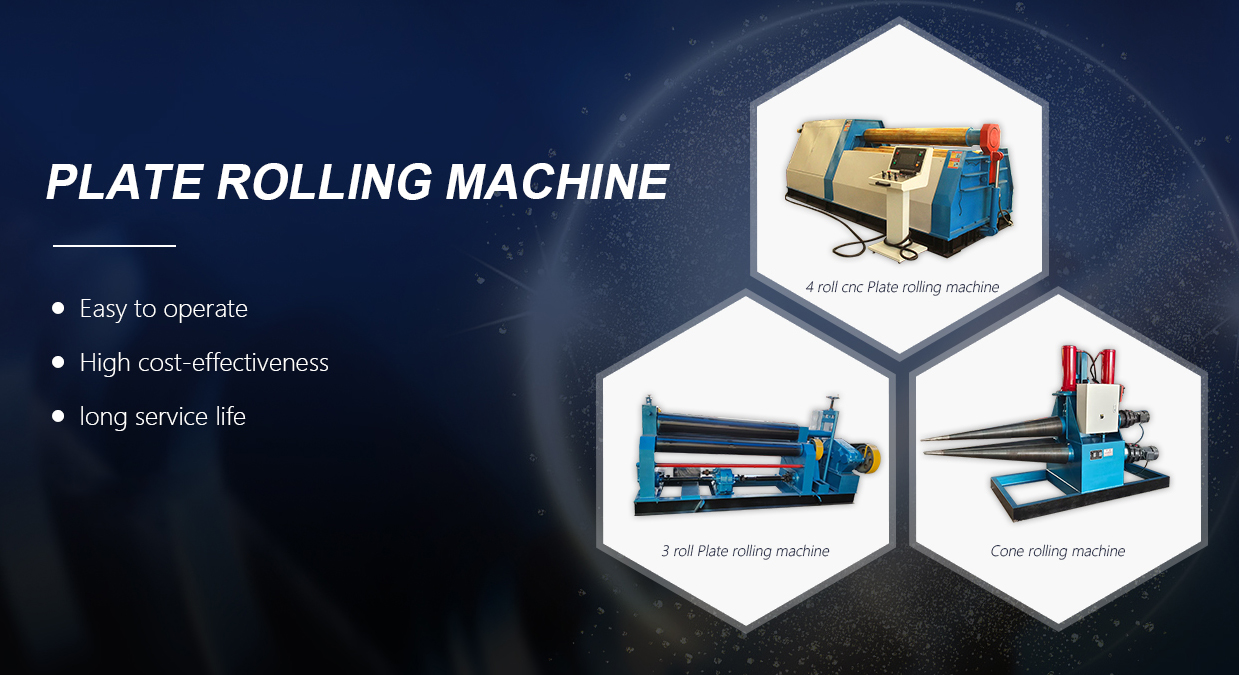
In pressure vessels, chemical equipment, environmental protection projects, storage tank manufacturing, chimneys, wind turbine towers, and various non-standard metal structures, conical components represent a highly common and critical structural form. In modern metal forming processes, the cone rolling machine stands as one of the core devices for achieving high-precision, high-efficiency conical processing.
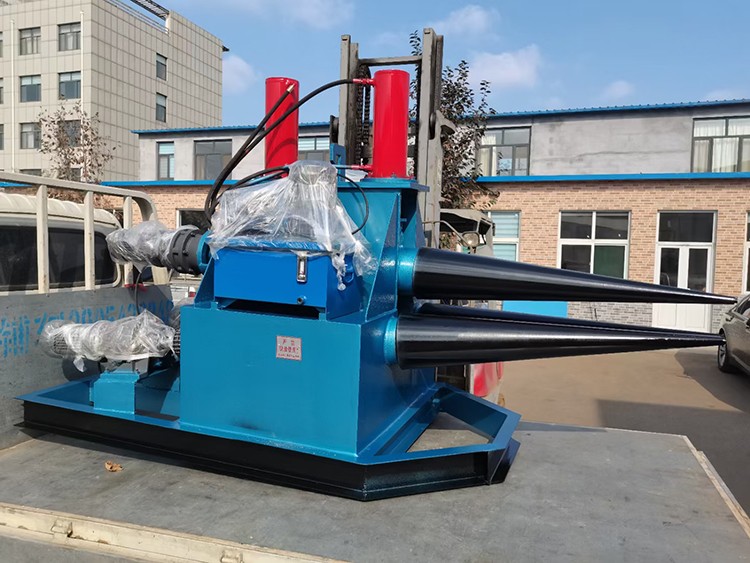
A cone rolling machine is a metal forming device optimized for conical structure processing needs, building upon traditional plate rolling technology. By adjusting roller shaft angles, implementing axial misalignment, or employing differential speed control, it enables metal sheets to form gradually changing diameters during rolling, achieving continuous shaping of cones or truncated cones.
Compared to standard cylindrical rolling, tapered processing demands higher precision, control capabilities, and operator expertise. Consequently, taper rolling machines typically feature:
- Adjustable roller angles to accommodate varying taper requirements;
- Continuous and stable forming processes;
- Excellent taper consistency with minimal roundness deviation;
- Suitable for thick plates and large-sized cone fabrication.
Thorough process preparation is essential to ensure cone quality prior to formal rolling.
Cones are typically defined by core parameters: large-end diameter, small-end diameter, cone height, and cone angle or taper. Based on design drawings, the three-dimensional cone structure must be accurately unfolded into a two-dimensional sector-shaped plate. The precision of this unfolding calculation directly impacts whether subsequent rolled sections can be successfully joined and welded.
Select appropriate materials based on operating conditions, such as carbon steel, stainless steel, or alloy steel. During cutting, ensure:
- Accurate dimensions
- Straight edges without significant burrs
- Plate thickness matches the rolling machine's capacity
- Chamfer edges when necessary to facilitate subsequent welding.
Before rolling, adjust the equipment according to the cone design parameters:
- Adjust the roller shaft angle or position to meet the taper requirements;
- Set an appropriate downward pressure to avoid excessive deformation in a single pass;
- Ensure all roller shafts operate smoothly and maintain good synchronization.
This is one of the most critical steps in cone rolling machine, directly determining the geometric accuracy of the cone.
Place the unfolded sheet at the feed end of the cone rolling machine, typically following these principles:
- Maintain proper alignment between the sheet centerline and the equipment axis;
- Ensure correct orientation of the large and small ends;
- Maintain a stable feed angle to prevent deviation.
For large or thick-plate cones, auxiliary lifting or multi-person coordination is often required.
Cone rolling is typically completed through multiple progressive forming passes:
- Initial pre-bending to establish the sheet's preliminary conical shape;
- Repeated rolling passes to progressively achieve the designed taper;
- Controlled rolling speed to ensure uniform stress distribution.
Compared to single-step forming, progressive rolling effectively reduces internal stresses and enhances forming quality.
After rolling, inspect the cone for:
- Whether the large and small end diameters meet design requirements;
- Uniformity of taper;
- Natural closure of the seam.
Minor deviations can be corrected through secondary adjustments or localized repairs.
In actual production, cone quality is primarily influenced by: the precision and rigidity of the cone rolling machine, the accuracy of roller shaft adjustments, operator experience, sheet material properties and thickness, as well as the number of rolling passes and speed control. The combination of equipment performance and operational expertise is the core guarantee for achieving high-quality cones.
(1) Precise taper control with consistent forming results
(2) High surface quality and uniform deformation
(3) High processing efficiency suitable for batch production
(4) Capable of processing large-sized, thick-plate cones
(5) Reduced manual finishing and material waste
Consequently, cone rolling machines have become the mainstream equipment in cone manufacturing.
In summary, utilizing cone rolling machines for cone fabrication represents a mature, efficient, and precision-controllable metal forming process. Every stage—from preliminary unfolding design and equipment parameter adjustment to progressive rolling and final product correction—directly impacts the quality of the finished cone. As manufacturing demands for larger dimensions, higher precision, and greater automation continue to rise, the application of cone rolling machines in cone processing will expand further. Through scientific process design and standardized operating procedures, cone rolling machines can reliably and consistently meet the manufacturing requirements for various cone structures, providing dependable support for pressure vessels, energy equipment, and engineering structures.
 Address:Room 1202, Detaitang Building, No. 118 Huaguang Road, Zhangdian District, Zibo, Shandong
 WhatsApp:+8615653328535
 Wechat: +8615965331535
  E-mail:zs@sdsmachinery.com