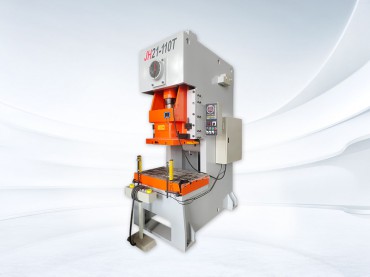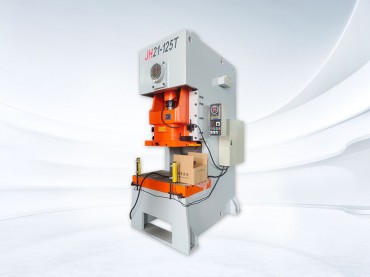
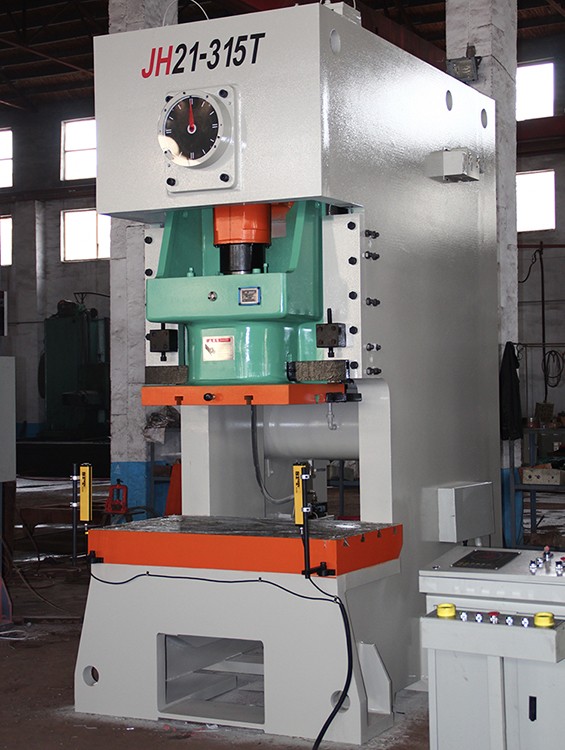
Pneumatic punch presses operate by using compressed air to drive a plunger. The specific working principle is as follows:
- An air compressor compresses and stores air.
- Stored air passes through a pressure reducer to lower pressure to the specified level before entering the cylinder.
- The cylinder begins operation, with the piston inside moving up and down as air pressure is transmitted.
- The piston connects to the punch. When the piston rises, kinetic energy is stored in the punch. When the piston descends, this energy is released, enabling the punch to perform high-frequency operations sustained by the press.
- No hydraulic oil leakage: The pneumatic system uses air as the medium, preventing environmental and workbench contamination from hydraulic oil leaks. This makes it particularly suitable for industries with high cleanliness requirements, such as food, pharmaceuticals, and electronics.
- Fire and explosion prevention: Compressed air is non-flammable, reducing fire and explosion risks. It is suitable for flammable and explosive environments.
- Fewer components: Primarily composed of cylinders, solenoid valves, and air tubes, the structure is simpler than hydraulic presses, resulting in lower failure rates.
- Easy maintenance: Eliminates the need for hydraulic oil changes or oil circuit cleaning. Routine maintenance involves only checking air source pressure and lubrication status, reducing maintenance costs by 30%-50%.
- High-frequency punching: pneumatic punch presses achieve ram speeds of 100-800 strokes per minute (depending on model), ideal for mass production of small components like electronic parts and connectors.
- Short-stroke advantage: pneumatic punch presses significantly outperform hydraulic presses in short-stroke applications (e.g., under 10mm).
- Adjustable Punching Force: Flexible control of punching force by regulating air supply pressure (typically 0.4-0.8MPa), accommodating varying material thicknesses (e.g., 0.1-6mm metal sheets).
- Rapid Die Change: Simplified structure reduces die change time to 10-20 minutes, ideal for multi-variety, small-batch production.
- Operating noise ≤75dB: Without the roar of hydraulic pumps, pneumatic punch presses generate significantly lower noise than hydraulic presses (typically above 85dB), meeting occupational health standards.
- Minimal standby energy consumption: Compressed air is used only during punching operations, with near-zero energy consumption during standby. Long-term use can reduce electricity costs by 20%-30%.
- Controllable compressed air costs: If the enterprise already has an air compressor, the operating costs of pneumatic punch presses can be further reduced.
(1) Metal Punching Industry: pneumatic punch presses are widely used in the metal punching industry, suitable for punching various metal and non-metal pipes and plates.
(2) Mechanical Industry: Suitable for processing stamped parts, metal stamping components, automotive stampings, drawn parts, metal drawn components, and sheet metal stampings in mechanical manufacturing.
(3) Household Goods: Most everyday furniture items are manufactured using pneumatic punching presses. Examples include electronics, communications equipment, appliances, lighting fixtures, toys, computer cases, furniture, sports equipment, barbecue utensils, lighting hardware, electronic hardware, enclosures, kitchenware, hinges, Cotter pins, spring pins, heavy-duty pliers, nutcrackers, packaging materials, stickers, phone screen protectors, gaskets, pads, aluminum components, terminals, speaker grilles, and other household items.
(4) Transportation: pneumatic punch presses are indispensable for producing automotive parts, transportation equipment, vehicles, protective gear, motorcycle components, and communication products.
(5) Office Supplies: Power distribution cabinets, air conditioning components, printer and copier frames, and various sheet metal parts.
In summary, pneumatic punch presses play a vital role in modern industrial production due to their high efficiency, precision, ease of operation, and energy-saving environmental benefits. Whether enhancing production efficiency, ensuring product quality, or reducing costs, pneumatic punch presses demonstrate significant advantages. Consequently, they are widely adopted across diverse manufacturing sectors, providing robust support for enterprise development and competitiveness enhancement.
 Address:Room 1202, Detaitang Building, No. 118 Huaguang Road, Zhangdian District, Zibo, Shandong
 WhatsApp:+8615653328535
 Wechat: +8615965331535
  E-mail:zs@sdsmachinery.com