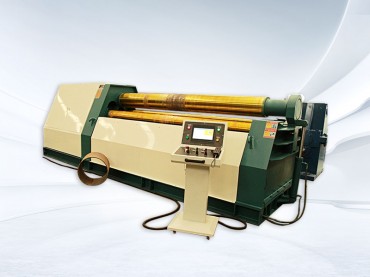
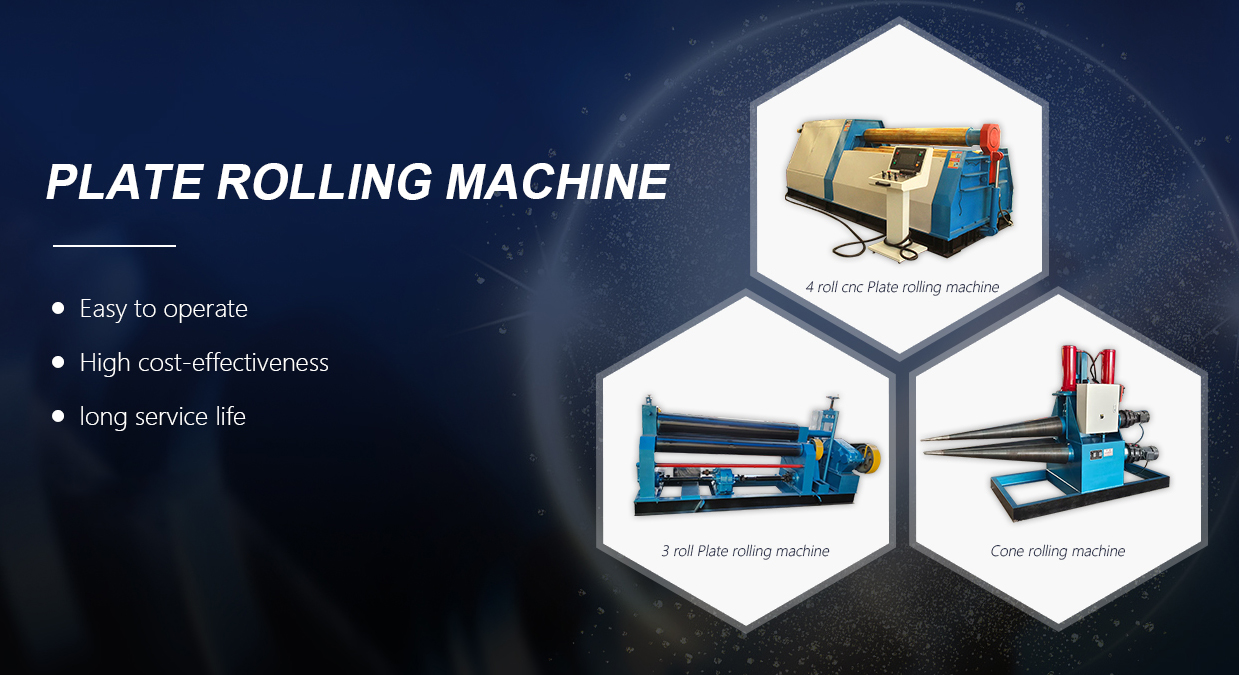
In the modern sheet metal processing industry, plate rolling machines serve as critical equipment for bending and forming metal sheets. They are widely applied in mechanical manufacturing, pressure vessels, shipbuilding, aerospace, chemical equipment, wind turbine towers, and other fields. Among various rolling machine configurations, the four-roll plate rolling machine has emerged as a mainstream industry solution due to its simplicity, high efficiency, precision, and safety. It not only enhances sheet metal forming quality but also significantly reduces manual labor complexity, serving as core equipment for enterprises seeking to boost production automation and product consistency.
Comprising an upper roll, lower roll, and two side rolls, four-roll plate rolling machines achieve synchronized operation through hydraulic or mechanical transmission. Their structure offers greater stability and reliability compared to three-roll models, featuring three key attributes:
Eliminates the need for material flipping, enabling the entire process—loading, pre-bending, and rolling—to be completed in a single operation.
Equipment can be fitted with a PLC control system, enabling digital settings to enhance precision and repeatability.
Particularly well-suited for rolling medium-to-thick plates, offering significantly improved efficiency compared to traditional equipment.
These structural advantages make the four-roll plate rolling machine the preferred choice for modern factories.
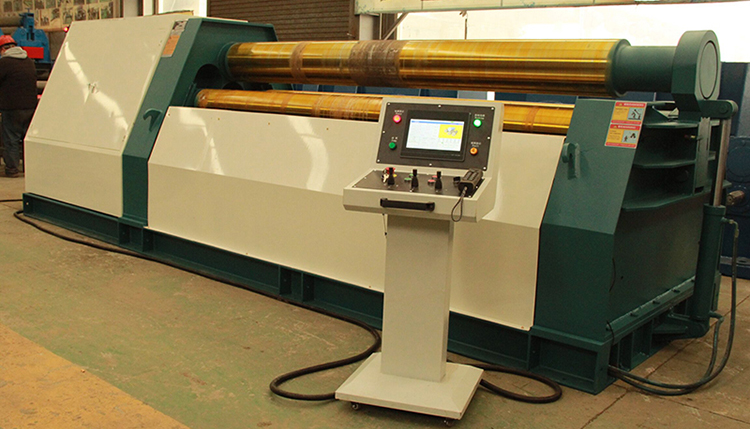
A key feature is the ability to perform dual-end pre-bending without flipping the plate.
- Precise clamping and positioning achieved through coordinated action of lower and side rolls;
- Upper roll applies pressure to form the pre-bend arc;
- Significantly reduces straight edge length at plate ends, enhancing forming precision;
Compared to three-roll plate bending machines, four-roll machines offer superior pre-bending capability and more time-efficient operation.
The core application of four-roll plate bending machines is rolling flat plates into cylindrical or arcuate structures.
- The upper roll serves as the primary drive roll, propelling the plate forward;
- The lower and side rolls adjust according to preset parameters;
- Capable of forming cylinders, curved segments, and conical structures of varying diameters;
With the upper and lower rolls maintaining constant clamping force, plate slippage is prevented during rolling, ensuring precision.
Four-roll plate bending machines also possess taper forming capability. Simply adjusting the side roll positions enables processing of various taper angles.
Advantages include:
- Convenient taper initiation;
- Wide adjustable taper range;
- Stable forming with minimal error;
Suitable for industries such as wind turbine towers, storage tank tapered sections, and environmental protection equipment.
The four-roll plate rolling machine enables automatic plate alignment through lateral adjustment of the side rolls.
- Prevents plate deviation;
- Ensures rolling accuracy and cylinder roundness;
- Reduces operational complexity, making it more novice-friendly.
This represents an advantage difficult to achieve with traditional three-roll plate rolling machines.
Beyond standard cylindrical rolling, four-roll plate bending machines can programmatically execute multi-segment arc rolling.
Examples include:
- Semi-circular structures;
- U-shaped structures;
- Multi-arc composite structures;
- Arc-shaped frame components.
This grants exceptional adaptability for non-standard part fabrication.
Modern four-roll plate bending machines can be equipped with PLC or CNC control systems to achieve:
- Automatic parameter logging;
- Automatic compensation;
- Automated rolling processes;
- High repeat positioning accuracy;
- One-button operation for enhanced efficiency.
High automation reduces reliance on manual expertise, ensuring more stable and reliable production.
The four-roll structure eliminates the need to flip plates, ensuring a smooth and continuous rolling process that significantly lowers operational complexity and labor demands.
With upper and lower rolls maintaining constant, secure clamping, the cylinders produced by four-roll plate bending machines exhibit high roundness, wrinkle-free surfaces, consistent curvature, and minimal joint errors. This meets the stringent precision requirements of high-end equipment manufacturing.
The four-roll configuration completes all processes with a single clamping operation, achieving 20%–50% faster rolling speeds than conventional three-roll machines.
The four-roll design offers greater structural stability. Combined with hydraulic systems and safety modules, it ensures safer and more reliable operation.
Four-roll plate bending machines are widely used across these sectors: pressure vessel manufacturing, boiler and tank production, wind turbine tower fabrication, shipbuilding, chemical machinery, stainless steel decoration projects, steel structure processing, environmental equipment (dust collectors, chimneys), and construction machinery manufacturing. Their efficiency and precision make them essential foundational equipment for enhancing competitiveness in modern manufacturing.
With its strong pre-bending capability, high rolling precision, simple operation, outstanding efficiency, and high automation level, the four-roll plate rolling machine is emerging as one of the mainstream devices in the metal forming field. As manufacturing demands for quality continue to rise, this equipment will deliver greater value across more industries, helping enterprises enhance production capacity and product competitiveness.
 Address:Room 1202, Detaitang Building, No. 118 Huaguang Road, Zhangdian District, Zibo, Shandong
 WhatsApp:+8615653328535
 Wechat: +8615965331535
  E-mail:zs@sdsmachinery.com