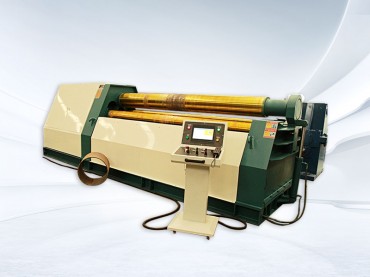
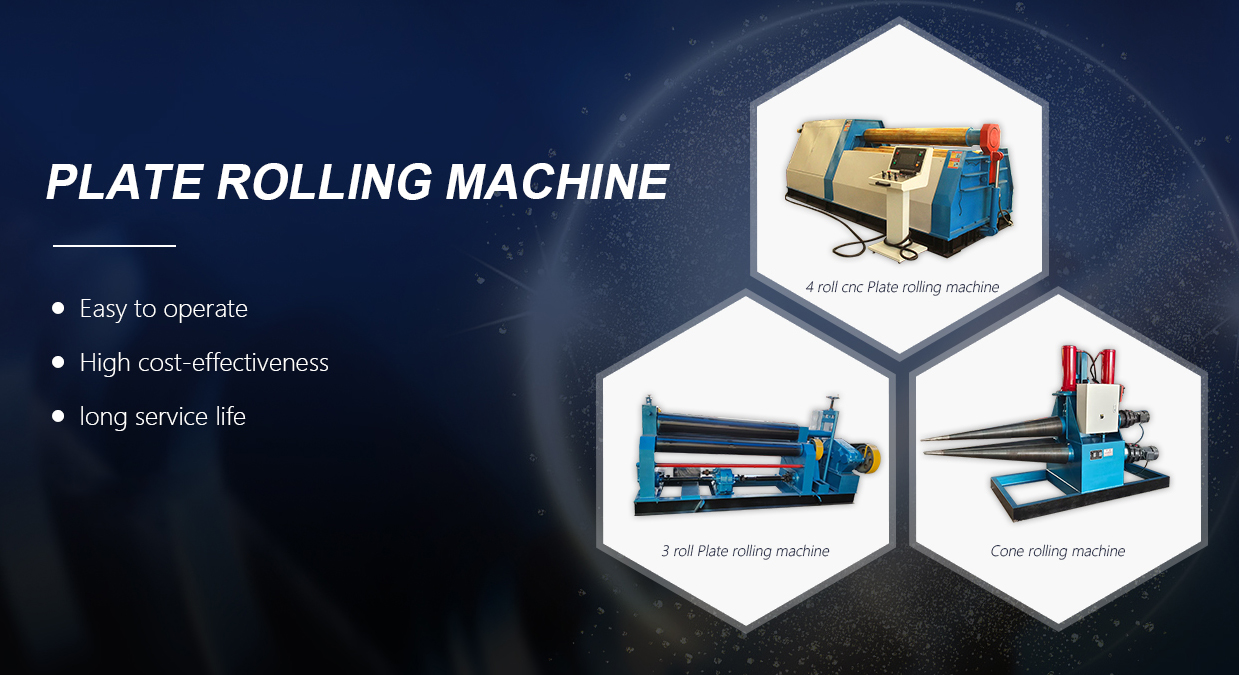
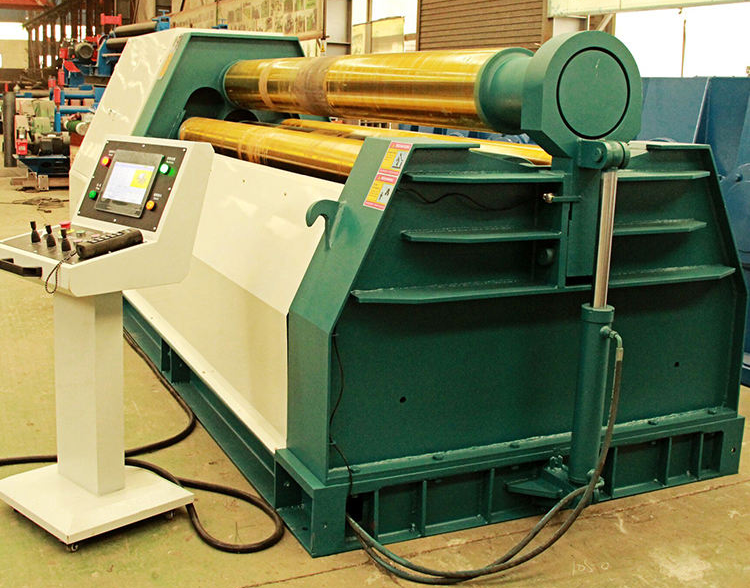
The core function of a CNC plate rolling machine is to bend metal sheets into desired curves through pressure and deformation. By adjusting the position and pressure of upper and lower rollers, the equipment precisely controls the bending degree of the sheet. Its advantage lies in processing metal sheets of varying thicknesses, widths, and materials to meet diverse specifications and shapes.
The CNC system programmatically controls the machine's operation, ensuring precision and consistency throughout the sheet processing. Operators only need to input parameters like material specifications, rolling radius, and bending angle for the machine to automatically complete the task, significantly boosting production efficiency and machining accuracy.
CNC plate rolling machine can bend sheets not only into circles but also into complex curves like ellipses and spirals as required. By adjusting the CNC system, they meet diverse bending demands for shapes and angles, finding extensive applications across various industries.
CNC plate rolling machines feature high automation, precisely executing tasks based on preset parameters. This results in products with minimal dimensional errors and high repeatability. Additionally, automated operation significantly increases production efficiency while reducing manual intervention time and workload.
CNC plate rolling machines can handle rolling of metal plates with varying thicknesses, widths, and materials. Whether processing steel plates, aluminum plates, or stainless steel plates, CNC rolling machines perform with ease. The equipment can also process different curved shapes, such as circular and elliptical forms, making it widely applicable in industries like shipbuilding, pressure vessels, and architectural structures.
Through automated CNC system control, operators only need to input basic parameters to complete plate rolling tasks. This not only boosts production efficiency but also minimizes errors and quality issues caused by manual operation.
CNC plate rolling machines precisely control every step of the processing cycle, ensuring maximum utilization of sheet metal. High-precision processing prevents material waste from dimensional inaccuracies, thereby lowering production costs.
In shipbuilding, CNC plate rolling machines are widely used for processing metal plates such as hull plates and ship structures. Since ship structures typically require large-area metal plates, these machines effectively perform extensive, high-precision bending operations.
Pressure vessels such as boilers, air tanks, and liquefied gas cylinders often require large-diameter metal plates for rolling. CNC plate rolling machines can easily process these specialized metal plates, ensuring the strength and durability of pressure vessels.
CNC plate rolling machines are also extensively used in the construction industry, particularly in the fabrication of steel structures and pipelines. Curved steel plates serve as support structures for large-span buildings, with CNC plate rolling machine guaranteeing structural precision and safety.
In bridge construction, CNC plate rolling machine produce curved steel plates for bridge components. These machines precisely process steel plates according to design drawings, ensuring the robustness and stability of bridge structures.
 Address:Room 1202, Detaitang Building, No. 118 Huaguang Road, Zhangdian District, Zibo, Shandong
 WhatsApp:+8615653328535
 Wechat: +8615965331535
  E-mail:zs@sdsmachinery.com