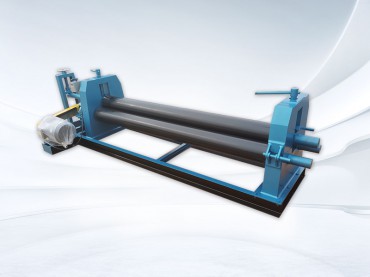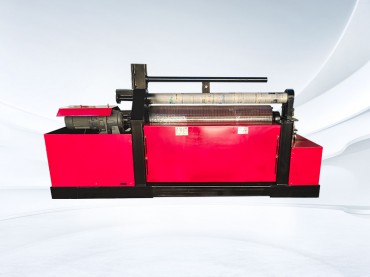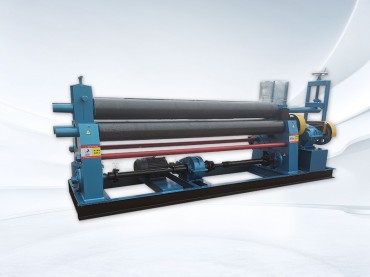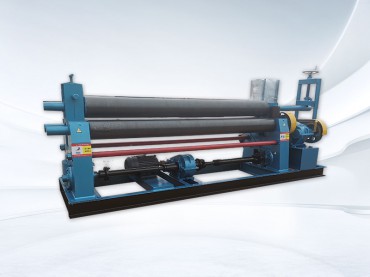
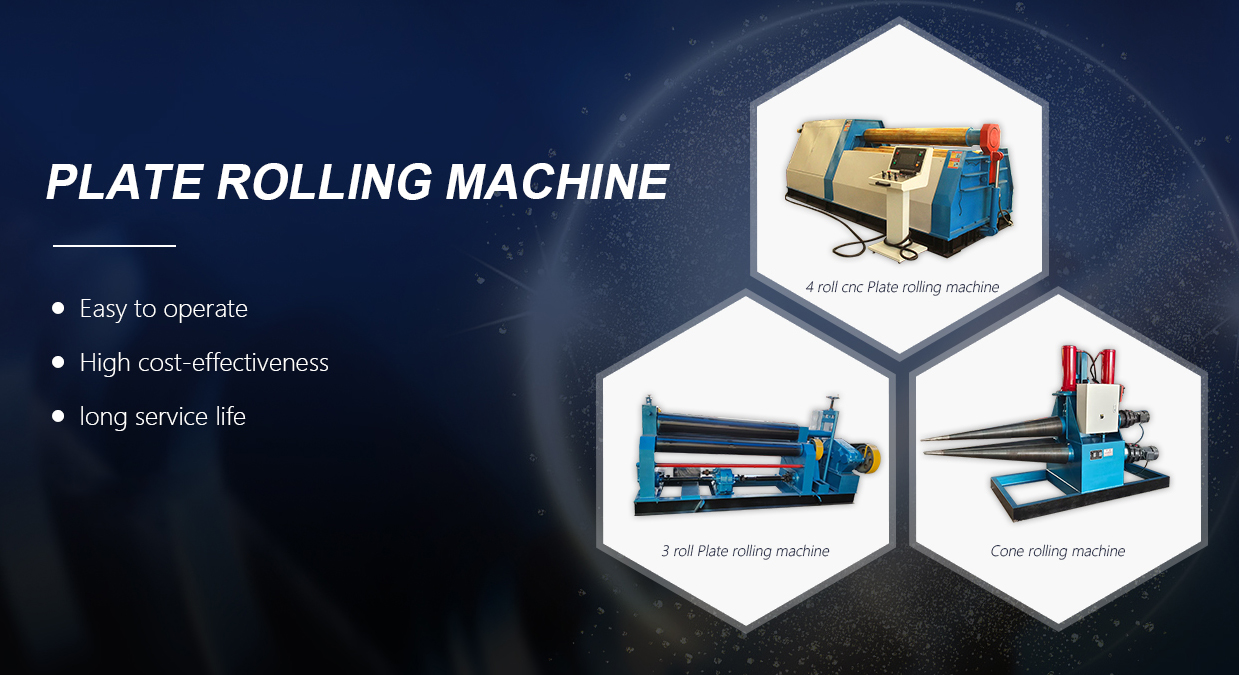
In modern metal processing, the three-roll plate rolling machine serves as a widely used plate metal forming equipment across various manufacturing sectors, particularly in shipbuilding, construction, machinery, chemical engineering, and energy industries. Compared to traditional plate rolling machines, the three-roll variant offers higher precision, greater operational flexibility, and enhanced production efficiency. Its primary function is to roll metal plates into circular or curved shapes to meet diverse production requirements.
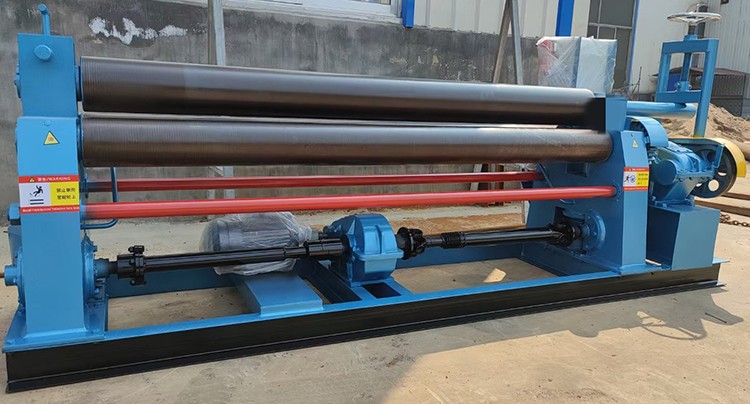
(1) Rolling Circular and Curved Plates: The fundamental function is to roll metal plates into circular or curved shapes. This process is widely applied in manufacturing pipes, pressure vessels, vehicle bodies, and other applications requiring circular or curved metal structures.
(2) Providing Stable Pressure: During rolling, the three rollers interact to deliver the necessary pressure, gradually rolling the metal plate into the desired shape. Specifically, the upper roller is typically the driven roller providing the primary force, while the lower rollers serve to support and guide the plate.
(3) Achieving varying curvature radii: By adjusting roller positions, the three-roller plate rolling machine can form metal plates with different curvature radii to meet diverse product requirements. Precise control ensures accurate plate forming.
(4) Preventing Plate Deformation and Damage: Compared to other types of rolling machines, the three-roll rolling machine maintains uniform force distribution on the metal plate during the rolling process. This prevents surface scratches or deformation, ensuring the surface quality of the formed plate.
The working principle of three-roll rolling machines primarily relies on the coordinated movement of the upper roll and two lower rolls to complete plate metal rolling. The specific steps are as follows:
(1) Upper Roll Presses Down the plate: First, the metal plate is positioned between the three rolls. The upper roll (drive roll) begins to descend, pressing the metal plate toward the lower rolls.
(2) Plate rolling Under Pressure: Under the pressure from the upper roll, the metal plate begins to bend along the curved surface of the lower rolls. At this stage, the lower rolls adjust their pressure based on the plate's thickness and material to support it, preventing excessive deformation.
(3) Forming Process: As the rolls continue to press and rotate, the plate gradually takes on the desired circular or curved shape. By controlling the positions of the upper and lower rolls, different curvature radii can be achieved for the plate.
(4) Adjustment and Finalization: After the initial rolling is completed, the upper roll gradually rises, and the plate is removed from between the three rolls, concluding the entire forming process.
During this process, the operator can adjust the pressure and position of each roll as needed to ensure the precision and quality of the plate forming.
Three-roll rolling machines are widely used across multiple industries, particularly in production processes requiring large-sized metal plates or specialized curved surface forming. Key application areas include:
(1) Shipbuilding Industry: During ship construction, three-roll rolling machines are employed to roll curved metal plates for hulls, especially hull shells and piping sections. This process yields high-precision curved plates, ensuring the hull's structural integrity and sealing performance.
(2) Pressure Vessel Manufacturing: For producing pressure vessels, three-roll plate rolling machines shape heavy steel plates into circular or curved forms. They are critical equipment in manufacturing high-strength pressure vessels, especially within the oil and gas industry.
(3) Construction Industry: Three-roll plate rolling machines are employed to form circular or curved metal components in building structures, such as steel roofs and walls. They enable construction projects to achieve more complex and aesthetically pleasing designs.
(4) Mechanical Manufacturing: These machines play a vital role in the mechanical industry, particularly in the production of large-scale machinery and steel structural components. By rolling metal plates, they enable the forming of various equipment and structural components.
(5) Chemical Industry: Chemical equipment requires precise rolling of metal plates to ensure structural strength and sealing integrity. Three-roll plate rolling machines meet this demand and are widely used in the production of chemical reactors, storage tanks, pipelines, and similar components.
Compared to other types of plate rolling machines, three-roll plate rolling machines offer the following unique advantages:
(1) High-Precision Forming: Three-roll plate rolling machines deliver stable and uniform pressure, enabling more precise rolling and forming of plates with minimal dimensional errors.
(2) Versatility: Capable of rolling metal plates of varying materials and thicknesses, demonstrating exceptional adaptability to meet diverse production demands.
(3) User-Friendly Operation: Modern three-roll plate rolling machines feature digital control systems, simplifying operation and facilitating adjustments to enhance production efficiency.
(4) Time and Cost Savings: Efficiently handles large-scale production, reducing labor costs and production time while boosting overall productivity.
With continuous advancements in manufacturing technology, three-roll plate rolling machines are undergoing constant innovation. Future developments will focus on greater intelligence and automation, manifested in:
(1) Intelligent Control Systems: Increasing adoption of digital and intelligent control systems will enhance operational precision and flexibility while elevating automation levels.
(2) Energy Efficiency: Future models will prioritize energy conservation and emissions reduction by adopting more efficient drive and control technologies, lowering energy consumption and minimizing environmental impact.
(3) Multi-Function Integration: Beyond basic rolling capabilities, future three-roll plate rolling machines may integrate additional functions such as punching and shearing, achieving higher production efficiency and process flexibility.
As a vital piece of equipment in metal processing, the three-roll plate rolling machine is widely used across industries including shipbuilding, construction, and pressure vessel manufacturing due to its high efficiency, precision, and flexibility. With the manufacturing sector's growing demand for high-precision, high-performance equipment, three-roll plate rolling machines will continue to play a significant role across various industries. Looking ahead, ongoing technological advancements and innovations will further enrich the capabilities of three-roll plate rolling machines and broaden their application scope, providing robust support for the global manufacturing industry's development.
 Address:Room 1202, Detaitang Building, No. 118 Huaguang Road, Zhangdian District, Zibo, Shandong
 WhatsApp:+8615653328535
 Wechat: +8615965331535
  E-mail:zs@sdsmachinery.com