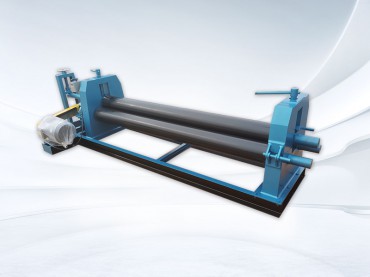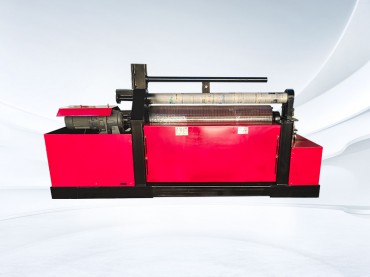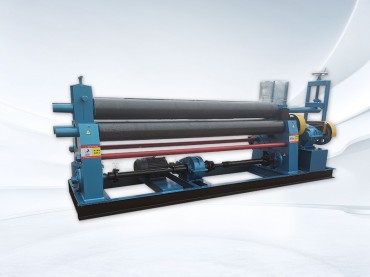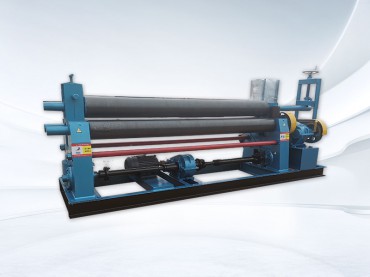
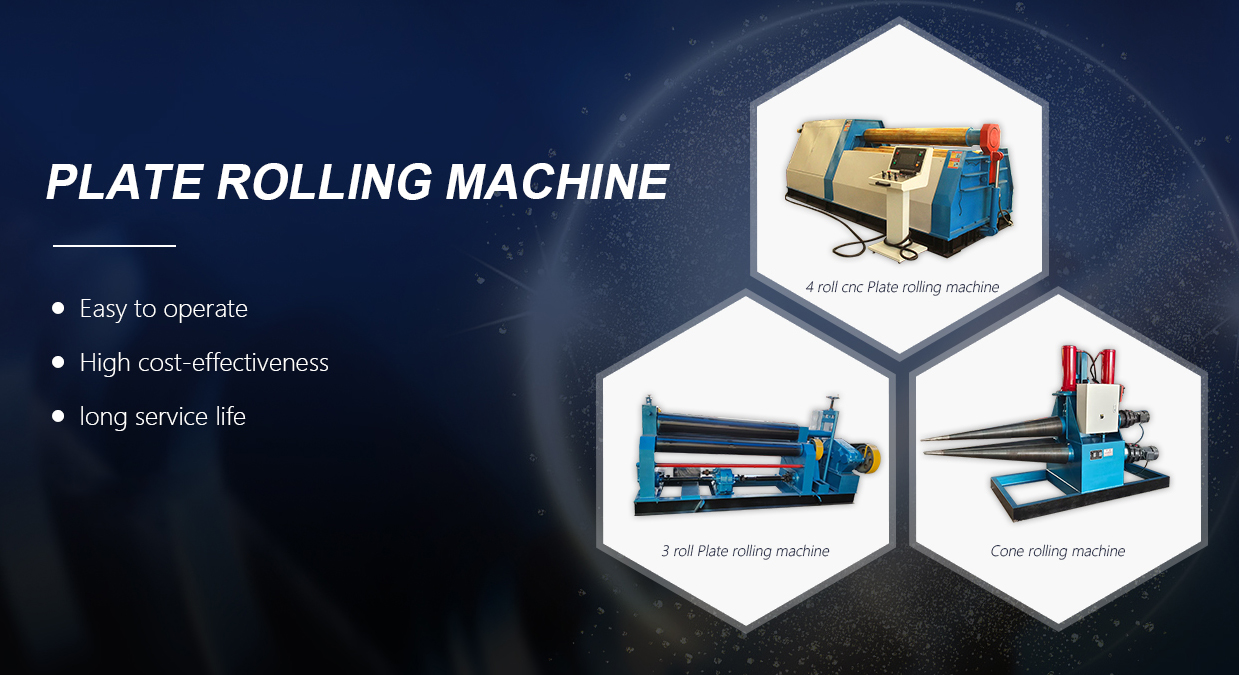
In the field of modern metal forming, plate rolling machines serve as critical equipment widely used in manufacturing products such as storage tanks, pressure vessels, wind towers, pipelines, ships, and building components. With the digital and intelligent upgrades in manufacturing, the structure and control methods of plate rolling machines are continuously advancing, transitioning from traditional mechanical operation toward automation and intelligent control. So, for operators, are plate rolling machines easy to operate?
The core function of a plate rolling machine is to roll flat metal sheets into circular, curved, or conical shapes. Its fundamental principle involves repeatedly rolling the sheet metal using multiple rollers (typically three or four rollers) to induce plastic deformation, thereby achieving the desired rolling radius.
- Three-roll plate rolling machine: Comprising upper, lower, and side rolls, it offers flexible operation and is suitable for small to medium-sized plates.
- Four-roll plate rolling machine: Adds a support roll to the three-roll structure, enabling single-pass pre-bending and forming with higher precision and simpler operation.
While this principle appears straightforward, it incorporates extensive engineering expertise and mechanical control technology in details such as equipment design, force control, and plate springback compensation.
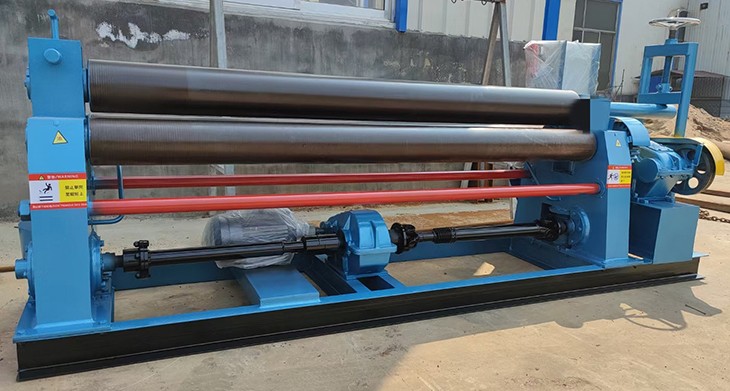
Traditionally, operating a plate rolling machine required experienced technicians who constantly adjusted roller positions, controlled pressure, and managed feed rates to achieve the desired shape. However, technological advancements have significantly streamlined the process, making today's roll forming machines truly “user-friendly, precise, and efficient.”
Modern roll forming machines commonly employ PLC or CNC control systems. Operators simply input parameters like sheet thickness, width, and roll diameter on the control panel. The system automatically calculates roller positions and pressure distribution, executing the entire forming process autonomously.
CNC plate rolling machines feature angle detection, torque sensing, and position compensation functions that automatically correct springback errors, ensuring finished product precision. Operators need not repeatedly test-roll; simply follow system prompts step-by-step, significantly minimizing deviations caused by human factors.
New plate rolling machines have optimized operating height, panel layout, and safety guards. For instance, a low-platform structure facilitates material loading and unloading; a touchscreen interface makes operation intuitive and easy to understand; and emergency stop and anti-misoperation systems enhance safety.
Previously, operating plate rolling machines required extensive hands-on experience. Now, the widespread adoption of CNC equipment has reduced training periods to days or even hours. Novices can complete routine rolling tasks after simple instruction, significantly lowering labor barriers.
Despite overall trends toward intelligent operation, the difficulty of operating plate rolling machines remains influenced by the following factors:
Traditional three-roll plate rolling machines involve relatively complex operations requiring manual pre-bending. Four-roll plate rolling machines, equipped with automatic pre-bending capabilities, offer more efficient rolling.
Rolling thick plates or large-diameter sheets demands precise control over accuracy and torque distribution, making operation more demanding. Rolling thin plates or small-to-medium-sized sheets is considerably easier.
Despite high system automation, operators' understanding of equipment performance and control logic remains crucial. Skilled technicians can leverage experience to determine optimal initial bending positions and tension distribution, thereby enhancing finished product precision.
Roll forming systems equipped with loading platforms, automatic feeding mechanisms, or robotic arms significantly reduce labor intensity, making operations easier, safer, and more efficient.
Despite increasing automation, safety and maintenance remain paramount. Before operation, verify the hydraulic system, limit switches, and emergency stop buttons are functioning correctly. During rolling, never place hands or feet near the roll shaft area. After shutdown, promptly clean oil residue and debris to ensure proper lubrication of transmission components. Regular maintenance not only extends equipment lifespan but also guarantees operational stability.
Overall, modern plate rolling machine operation has shifted from “experience-based” to “intelligent.” Thanks to automated control systems, digital technology, and ergonomic design, the operation process has become simpler, safer, and more precise. For metal processing enterprises—whether small workshops or large manufacturing plants—plate rolling machines have become essential equipment for enhancing production efficiency and product quality.
With the advancement of smart manufacturing, future plate rolling machines will continue to evolve toward greater efficiency, precision, intelligence, and user-friendliness, providing more stable and convenient productivity support for the metal forming industry.
 Address:Room 1202, Detaitang Building, No. 118 Huaguang Road, Zhangdian District, Zibo, Shandong
 WhatsApp:+8615653328535
 Wechat: +8615965331535
  E-mail:zs@sdsmachinery.com