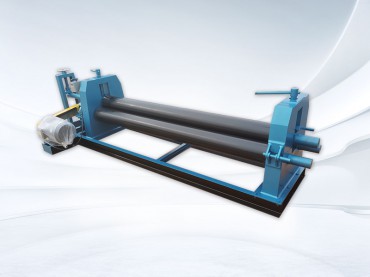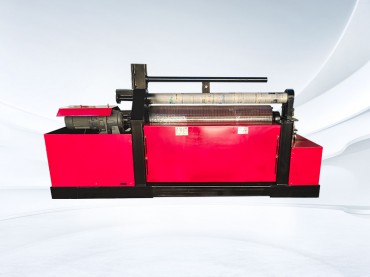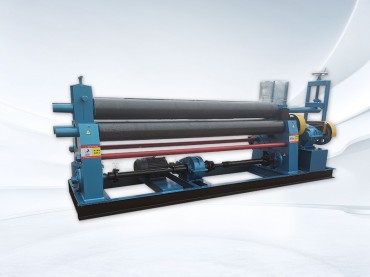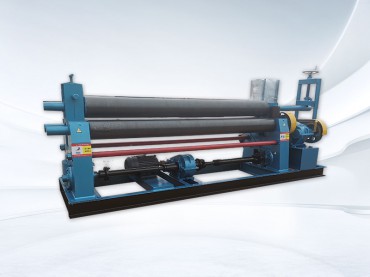
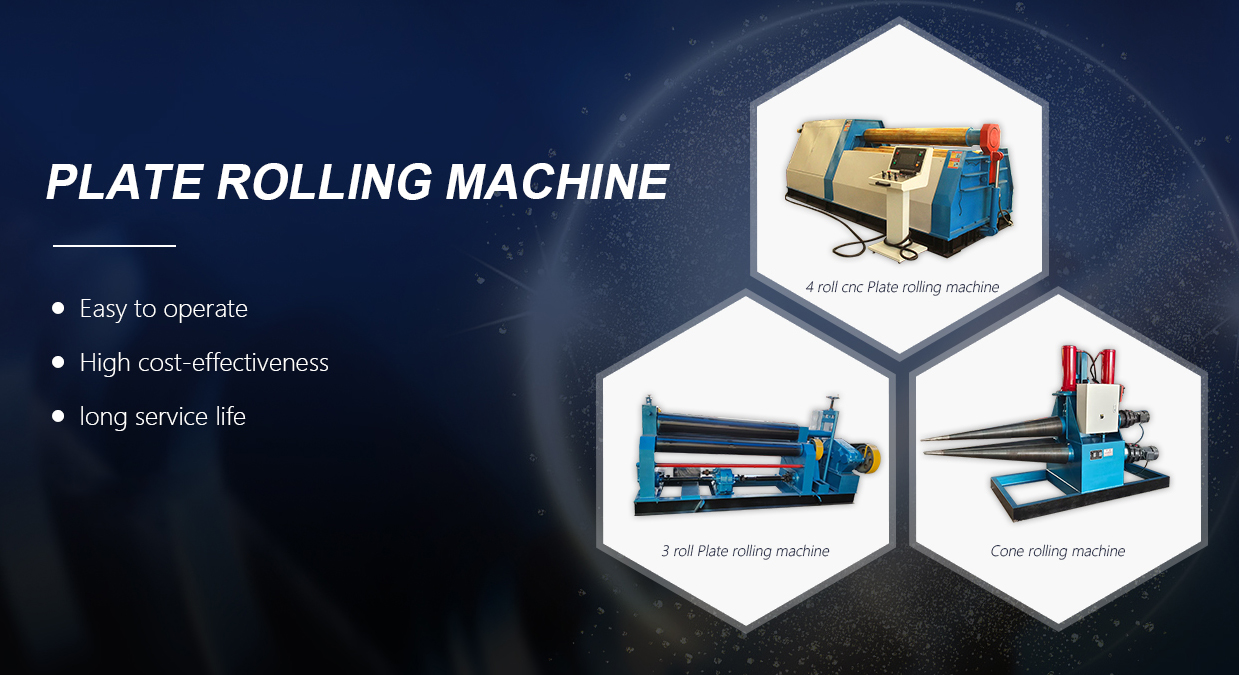
In the field of metal processing, plate rolling machines are crucial forming equipment. Among them, four-roll plate rolling machines have gradually become the preferred choice for industry users due to their high precision, efficiency, and broad applicability. Compared to traditional three-roll plate rolling machines, four-roll plate rolling machines demonstrate significant advantages in operational convenience, processing efficiency, forming precision, and versatility. They are widely applied across critical industries such as shipbuilding, aerospace, wind power, storage tanks, and railway tank cars.
(1) Plate Placement: Position the metal plate precisely between the upper and lower rolls.
(2) Roll Adjustment: The lower right roll descends to create space while the lower left roll ascends, coordinating with the upper roll to clamp the plate securely.
(3) Rolling Forming: The machine drives the plate through gradual rolling, applying uniform force to progressively bend it into shape.
(4) End Seaming: The plate ends are finally joined to form a closed cylindrical structure.
Equipped with an automatic sheet clamping system, ensuring the sheet remains fully supported throughout the rolling process. Even novice operators can easily achieve precise pre-bending and tapered rolling.
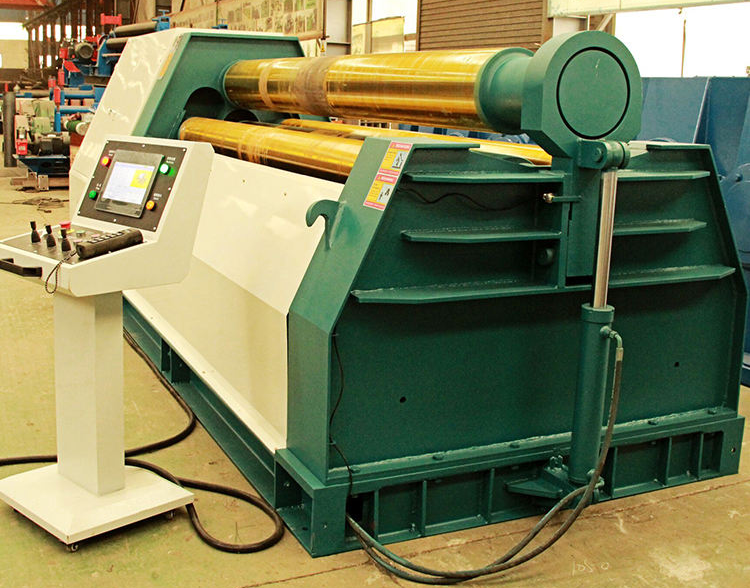
Its pre-bending capability limits the flat end length to within 1.5 times the sheet thickness, delivering over twice the production efficiency of traditional three-roll plate rolling machines.
Simultaneous force application across multiple rolls ensures uniform stress distribution and stable rolling trajectories. Independent shaft design further improves accuracy and consistency.
Simultaneous pre-bending and rolling eliminates intermediate handling or additional operations, reducing trimming waste, material loss, errors, and rework—lowering overall costs.
Tilting bottom and side rolls, combined with rotating guide blocks (taper shoes), enable precise forming of: cylinders, round tubes, variable-diameter pipes, semicircles, half-pipe structures, various conical shapes (different apex angles, eccentric cones), ellipses, and elliptical-to-circular transitions.
Constructed from thick steel plates and high-quality components, the four-roll plate roller withstands heavy-duty workloads. Premium equipment (e.g., Longxu Heavy Industry) utilizes universal parts for global interchangeability and supports localized service.
It processes plates ranging from 2mm thin to 150mm thick, fully covering and surpassing the processing range of three-roll machines.
Used for forming hulls, decks, bulkheads, propellers, and other components.
The conical nose and cylindrical main body of rocket casings demand extreme precision, making four-roll machines the preferred solution.
Wind towers and their internal structures require precision rolling of thick steel plates, where four-roll machines provide highly efficient solutions.
Long-term pressure-bearing applications demand exceptional steel plate strength, and four-roll plate rolling machines efficiently process related components.
Additionally, four-roll plate rolling machines are widely used in grain silos, construction machinery, pressure vessels, and other industries, significantly enhancing production efficiency and delivery speed.
When using plate rolling machines, strict adherence to a series of safety operating procedures is mandatory to ensure the safety of both operators and equipment.
(1) Plate rolling machines must be managed by designated personnel to ensure equipment safety and stability.
(2) Operators must thoroughly understand the machine's performance and operating methods and may only operate after obtaining permission from the responsible manager.
(3) Before startup, thoroughly inspect all safety devices to confirm they are intact and functioning properly.
(4) During operation, never place hands or feet on the rollers, transmission components, or workpieces.
(5) When work is interrupted, ensure the clutch is disengaged.
(6) For collaborative tasks, designate a specific person to direct operations to ensure coordinated and orderly work.
(7) Never overload the plate rolling machine to ensure its service life.
(8) Adjustments to the upper roller's elevation, tilting bearing reset, and upper roller balancing must only be performed after the main drive has been shut down.
(9) Maintain a clean work area. Do not randomly stack workpieces or debris to ensure the machine and workspace remain tidy.
(10) After completing operations, immediately disconnect the power supply and lock the power box to ensure equipment safety.
With its notable advantages of simple operation, high efficiency and stability, multifunctionality, and broad applicability, the four-roll plate rolling machine is progressively replacing traditional rolling equipment to become the core machinery in the metal forming industry. It not only significantly enhances production efficiency and finished product quality but also reduces costs and labor dependency, aligning with modern manufacturing demands for intelligent, precision, and high-efficiency solutions.
 Address:Room 1202, Detaitang Building, No. 118 Huaguang Road, Zhangdian District, Zibo, Shandong
 WhatsApp:+8615653328535
 Wechat: +8615965331535
  E-mail:zs@sdsmachinery.com