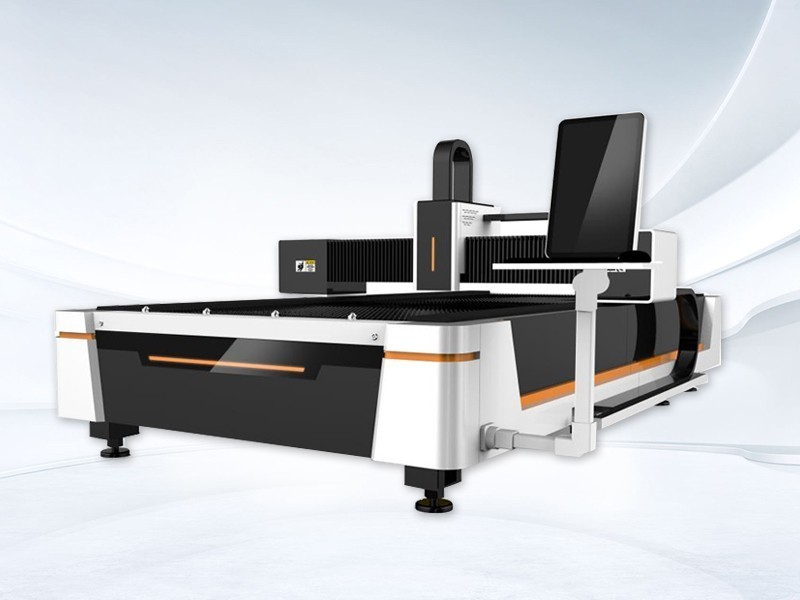
In the field of modern metal processing, fiber laser cutting machines have become the core equipment for precision manufacturing due to their high efficiency, flexibility, and excellent cutting quality. When processing tasks are directed towards fields such as aerospace, precision electronics, medical equipment, and high-end molds that have strict requirements for tolerances and cross-sectional quality, the configuration of fiber laser cutting machines cannot be limited to ordinary standards, but requires a targeted and ultimate scientific planning. A successful 'high-precision configuration' is the result of the synergistic effect of optical components, mechanical structures, control systems, and auxiliary systems.
1. Optical Core: The Source of Accuracy and Quality
The optical system is the soul of fiber laser cutting machines, and its configuration directly determines the upper limit of cutting ability.
1. Selection of laser power: High precision cutting is not just about pursuing high power. For stainless steel and carbon steel with a thickness of less than 3mm, as well as thinner copper aluminum alloys, medium to low power (such as 500W to 1500W) is often a better choice. Excessive power in cutting thin plates can easily lead to excessive melting, difficult slag control, and even thermal deformation, affecting dimensional stability. The core lies in the power stability of the laser (usually within ± 2%) and the beam quality (low M ² factor, preferably close to 1.0), which ensures consistent energy output throughout the entire processing process, thereby obtaining a uniform and smooth cutting surface.
2. Precise configuration of cutting head:
Adjustable focus cutting head: This is essential for high-precision applications. It allows real-time dynamic adjustment of the focus position through the program to adapt to different materials and thicknesses. When cutting different materials, the optimal focal position varies (for example, stainless steel often uses negative defocusing, while carbon steel uses positive defocusing).
High quality focusing and protective lenses: Imported or top-quality domestically produced optical lenses with high purity and high transmittance must be selected. Any small flaw or contamination can cause energy loss, beam distortion, and thus affect cutting sharpness and perpendicularity. Meanwhile, configuring an automatic lens cleaning system can effectively maintain the long-term stability of the optical system.
Capacitive height regulator: High precision non-contact capacitive height regulators are crucial. It can monitor the distance between the nozzle and the surface of the board in real time and control it within a very small fluctuation range (such as ± 0.05mm). A constant cutting nozzle height is a prerequisite for ensuring the stability of the cutting gas flow field and obtaining consistent cutting quality, especially when dealing with uneven sheets.
2. Mechanical structure: the cornerstone of stability
Even the most sophisticated optical system requires a sturdy and stable mechanical platform to support it. The accuracy of fiber laser cutting machine is the basis for ensuring repeat positioning accuracy and dynamic processing accuracy.
1. Bed structure and driving mode:
Whole steel plate welding/casting bed body: Multiple reinforcement structures optimized through finite element analysis (FEA) must be used, and stress relief annealing treatment must be carried out to ensure the geometric accuracy of the foundation platform under high load and long-term operation without deformation.
Drive system: For high-precision models, a fully closed-loop control system should be preferred. It uses servo motors combined with high-precision linear grating rulers to directly read the actual position of moving parts and provide feedback to the control system. Compared to a semi closed loop system (which only reads feedback from the motor encoder), it can effectively compensate for errors such as screw thermal elongation and backlash, pushing the positioning accuracy and repeatability accuracy to the extreme (usually within ± 0.03mm/m).
Guide rail and screw: High precision and high preloading linear guide rails and precision ball screws are selected to ensure rigidity and stability during motion, avoiding crawling and vibration.
2. Dynamic performance of machine tools:
On the premise of ensuring structural rigidity, optimize the lightweight design of the crossbeam and match it with a high torque servo motor to achieve higher acceleration. High dynamic performance means that when cutting complex contours, small circular holes, and sharp corners, the machine tool can respond faster, reduce overshoot and jitter, thereby ensuring precise restoration of geometric shapes.
3. Control systems and software: the "brain" and "nerve" of precision
The control system is the command center of the fiber laser cutting machine, and its level of intelligence directly determines the success or failure of precision control.
1. CNC system: A high-end CNC system optimized for laser cutting depth should be selected. It not only needs to have fast computing speed, but also rich precision compensation functions, such as:
Pitch error compensation: Measure the accuracy error of each point of the screw and compensate it with software.
Verticality compensation: Ensure absolute verticality of X and Y axis movements.
Focus position control: linked with the cutting head to achieve precise programming of focus changes.
Real time seam compensation: Based on the thickness of the board and process parameters, the cutting path is automatically adjusted to offset the influence of seam width on the size of the workpiece.
2. Programming and Process Database:
Equipped with professional laser cutting CAM software, supporting efficient layout and path optimization. For high-precision parts, the introduction of lead out design and sharp corner processing strategies (such as "rounding" or "micro connection") in the cutting path is crucial to effectively avoid corner burning and deformation.
Built in powerful and customizable process parameter database. There are validated optimized parameter combinations (power, speed, air pressure, duty cycle, frequency) for different materials, thicknesses, and surface states (such as film and rust), which are key to achieving "one click" high-quality cutting.
4. Auxiliary system: an indispensable guarantee
A precise machining environment requires equally precise auxiliary systems to maintain.
1. Cooling system: The laser and cutting head generate a large amount of heat during operation, and high-precision industrial chillers must be configured. Require high temperature control accuracy (such as ± 0.5 ° C), stable flow rate to ensure the stability of laser output wavelength and power, and protect optical components.
2. Gas system:
Gas source purity: Whether it is oxygen used for cutting carbon steel or nitrogen used for cutting stainless steel and aluminum, its purity must reach 99.95% or above (even high reflective materials require 99.999%). Any impurities will form defects in the cutting surface.
Pressure stability: Multiple pressure reducing valves and high-precision stabilizing valves must be installed to ensure minimal gas pressure fluctuations throughout the entire cutting process. Unstable air pressure can lead to uneven cross-sectional roughness and slag deposition.
5. Usage environment and professional operation and maintenance
1. Environmental requirements: The high-precision fiber laser cutting machine should be installed in a clean workshop with constant temperature and humidity, sturdy ground, and few vibration sources. The drastic changes in environmental temperature can affect the geometric accuracy of the machine tool, and vibration can directly interfere with the cutting process.
2. Professional training and maintenance: Operators and maintenance personnel need to undergo strict training to understand the principles and process logic of fiber laser cutting machines. Regular precision calibration, cleaning and replacement of optical lenses, and maintenance of guide screws are institutional guarantees for maintaining equipment in a high-precision state for a long time.
In summary, configuring fiber laser cutting machines for high-precision requirements is a systematic project. It requires users to shift from a "power only theory" to a deep consideration of comprehensive details such as "beam quality, mechanical rigidity, control loop, gas purity, and process database". This configuration pursues ultimate stability and repeatability, ensuring that every product, whether at the beginning of processing or after several hours of continuous operation, can achieve equally excellent precision and quality. This is not only the procurement of equipment, but also a strategic investment in high-end manufacturing capabilities.

 Address:Room 1202, Detaitang Building, No. 118 Huaguang Road, Zhangdian District, Zibo, Shandong
 WhatsApp:+8615653328535
 Wechat: +8615965331535
  E-mail:zs@sdsmachinery.com