
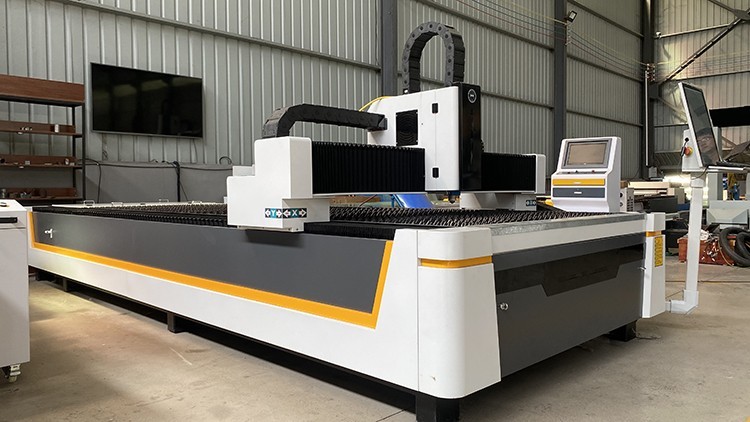
In the grand landscape of modern manufacturing, plate laser cutting machines are like a shining star, standing out among numerous processing equipment with their unique and outstanding advantages, and becoming a key force driving the development of the industry. The following will delve into the significant advantages of plate laser cutting machines from multiple dimensions.
The core of a plate laser cutting machine lies in its high-energy density laser beam. When the laser beam is focused by a precise optical system, it can form extremely high power density in a very small area. This focal point is like an incredibly sharp 'light knife', with a diameter that can be precisely controlled within a very small range, typically between 0.1mm-0.3mm. Such precise focusing points enable the plate laser cutting machine to accurately locate the position that needs to be cut, just like a skilled surgeon who can perform surgical operations accurately and without error. In the field of electronic component manufacturing, for some small-sized and structurally complex circuit boards, plate laser cutting machines, with their high-precision positioning ability, can accurately cut various shapes of circuits and holes according to design requirements, ensuring the performance and quality of electronic components.
In industrial production, batch production of components requires a high degree of consistency, which is the key to ensuring stable product quality. Laser cutting machines have excellent repeatability, which means that they can always maintain the same cutting accuracy and size when cutting the same specification of sheet metal multiple times. This repeatability is due to the advanced numerical control system and precise mechanical transmission device of the plate laser cutting machine. The numerical control system is like an intelligent brain that can accurately control the motion trajectory and cutting parameters of the laser beam; And the mechanical transmission device is like a precise limb, ensuring that the laser head moves accurately along the predetermined path. Taking the automobile manufacturing industry as an example, in the production of automobile body parts, a large number of steel plates of the same shape and size need to be cut. The repeatability of the plate laser cutting machine can ensure that every component meets the design requirements, thereby ensuring the consistency of the overall quality and performance of the car.
Modern manufacturing industry is facing the challenge of diversified and personalized market demand, and enterprises need to be able to quickly adjust production plans to meet the customized needs of different customers. Laser cutting machines have the ability to respond quickly. They can quickly change the cutting pattern and size through simple numerical control programming, achieving cutting of different shapes and specifications of sheets. This flexibility enables enterprises to quickly produce various customized products without replacing equipment or molds. For example, in the advertising production industry, customers have different requirements for the shape and size of billboards. Laser cutting machines can complete the cutting and processing of the metal frame of billboards in a short period of time according to customers' design requirements, greatly improving the market competitiveness of enterprises.
Traditional cutting methods, such as stamping, die-cutting, etc., usually require the production of specialized molds. The production of molds not only requires a lot of time and capital, but also increases production costs and cycles for small batches and multiple varieties of production needs through mold replacement and adjustment. Laser cutting machines do not require the production of molds and can directly cut according to computer programs, greatly reducing production costs and cycles. For some emerging startups or small-scale production enterprises, the advantage of plate laser cutting machines is particularly important. They can quickly launch new products, meet market demand, and enhance the competitiveness of the enterprise without investing a large amount of funds in mold production.
Due to the plate laser cutting machine's ability to accurately cut according to design requirements, it reduces the production of scraps during the cutting process. The reduction of scraps not only means a decrease in material waste, but also reduces the consumption of resources. Against the backdrop of increasingly scarce global resources, this advantage holds significant importance. At the same time, reducing scraps can also lower the cost of waste disposal for enterprises and achieve green production. For example, in some metal processing enterprises, by using plate laser cutting machines, a large amount of metal scraps can be reduced every year, saving considerable funds for the enterprise and also meeting the policy requirements of national sustainable development.
The cutting process of a plate laser cutting machine is a fast and localized heating and cooling process, with a very small heat affected zone. The heat affected zone refers to the area where a material undergoes performance changes due to the influence of heat during the cutting process. In traditional thermal cutting methods such as flame cutting and plasma cutting, the heat affected zone is relatively large, which can cause changes in the hardness, strength, and other properties of the material, affecting the quality of the product. The heat affected zone of plate laser cutting machines is usually only tens to hundreds of microns, which has minimal impact on the performance of materials. In industries that require high material performance, such as aerospace and nuclear industries, the advantage of plate laser cutting machines can ensure the quality and reliability of components.
As mentioned earlier, plate laser cutting machines do not require the production of molds, which saves enterprises the cost of mold production. At the same time, for some production needs that require frequent changes in product specifications and shapes, plate laser cutting machines do not need to replace molds, and can quickly adjust cutting parameters through CNC programming, greatly reducing production preparation time and downtime. This advantage enables enterprises to respond more flexibly to market changes, improve production efficiency and economic benefits.
 Address:Room 1202, Detaitang Building, No. 118 Huaguang Road, Zhangdian District, Zibo, Shandong
 WhatsApp:+8615653328535
 Wechat: +8615965331535
  E-mail:zs@sdsmachinery.com


