The three-roller rolling machine, as a key equipment for metal sheet bending and forming, plays an important role in industrial manufacturing. Among them, rolling the large and small heads (i.e. conical cylinder) is a challenging but widely used operation. The following will provide a detailed introduction to the method of using a three-roller rolling machine to roll large and small heads.
1. Principle of Three-roller Rolling Machine for Rolling Large and Small Heads
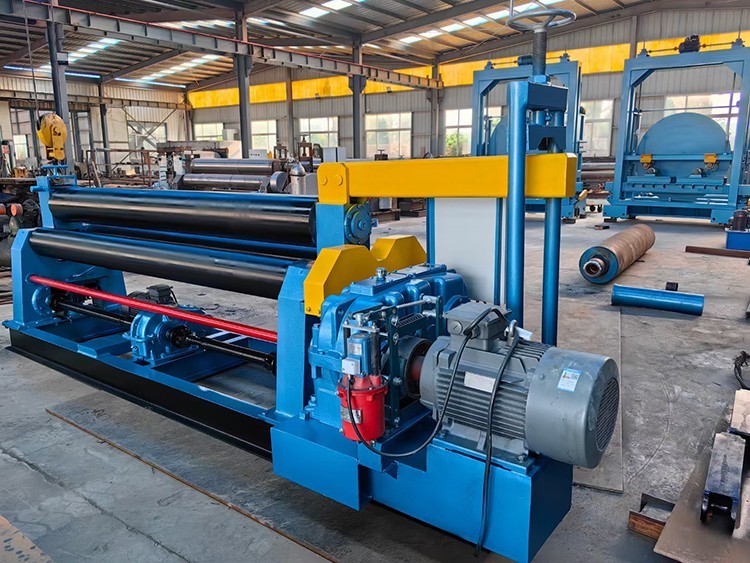
The rolling of large and small heads by a three-roller rolling machine is mainly based on the principle of bending deformation of the plate between three rollers. By adjusting the vertical position of the upper roller and the horizontal position of the lower roller, the sheet is subjected to uneven pressure during rolling, thereby achieving the rolling of the conical cylinder. The downward pressure of the upper roller determines the degree of bending of the sheet, while the horizontal movement of the lower roller controls the taper of the sheet.
2. Preparation work
1. Equipment inspection
Before starting the rolling process, it is necessary to conduct a comprehensive inspection of the three-roller rolling machine. Ensure that the upper and lower rollers rotate flexibly without any jamming phenomenon; The hydraulic system pressure is normal, and all valve switches are smooth; The electrical system wiring is firm and there are no safety hazards such as short circuits or leakage.
2. Board preparation
Select suitable materials, thicknesses, and sizes of boards according to design requirements. Pre treat the board, such as removing surface rust, oil stains, and other impurities, to ensure a smooth and even surface of the board. At the same time, the parameters of the rolling machine should be set reasonably according to the thickness and material of the board.
3. Operation steps
1. Initial positioning
Place the board on the lower roller of the three-roller rolling machine, adjust the position of the board so that its centerline coincides with the centerline of the bending machine. Then, operate the upper roller to descend and gently contact the upper roller with the board, playing a role in fixing the board.
2. Adjust the roller position
Adjust the horizontal position of the lower roller according to the required taper of the conical cylinder to be rolled. Generally speaking, the lower roller near the small end of the board should move outward, while the lower roller near the large end of the board should remain stationary or move inward by a small distance. At the same time, the downward pressure of the upper roller should be adjusted according to the thickness and bending degree of the board.
3. Exam paper
Slowly rotate the lower roller to start rolling the sheet. During the rolling process, observe whether the bending and taper of the board meet the requirements. If any deviation is found, stop rotating in a timely manner, adjust the position of the roller and the downward pressure of the upper roller, and then proceed with the test paper again.
4. Formal Rolling
After multiple adjustments and examination papers, when the bending and taper of the board meet the design requirements, formal rolling can be carried out. During the rolling process, it is important to maintain a uniform rotational speed to avoid situations where the speed is too fast or too slow, which may affect the quality of the rolling.
4. Quality inspection and subsequent processing
After the rolling is completed, quality inspection should be carried out on the conical cylinder. Check whether the taper, roundness, straightness, etc. of the cylinder meet the design requirements. If there is any deviation, it can be corrected by local heating or adjusted by using the rolling machine again. Finally, surface treatment such as grinding, painting, etc. should be carried out on the rolled conical cylinder to improve its appearance quality and corrosion resistance.
The three-roller rolling machine rolls the large and small ends, and the installation of a rolling cone device is the foundation. The tapered roller supports the small end to achieve gradual curvature; The adjustment of roller parameters is crucial, with precise control of spacing and inclination, combined with segmented pressure and curvature detection, to ensure accurate taper; The auxiliary mold and end pre bending function are indispensable, which can improve molding accuracy and reduce straight edge residue. By strictly following these methods, the three-roller rolling machine can efficiently and accurately roll out large and small heads, meeting the processing needs of different workpieces.

 Address:Room 1202, Detaitang Building, No. 118 Huaguang Road, Zhangdian District, Zibo, Shandong
 WhatsApp:+8615653328535
 Wechat: +8615965331535
  E-mail:zs@sdsmachinery.com