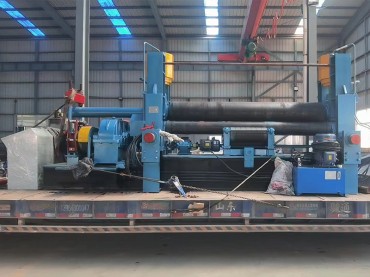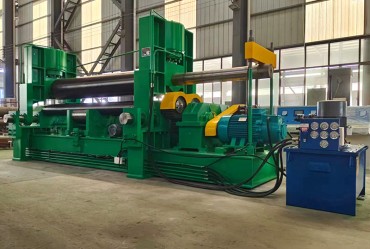
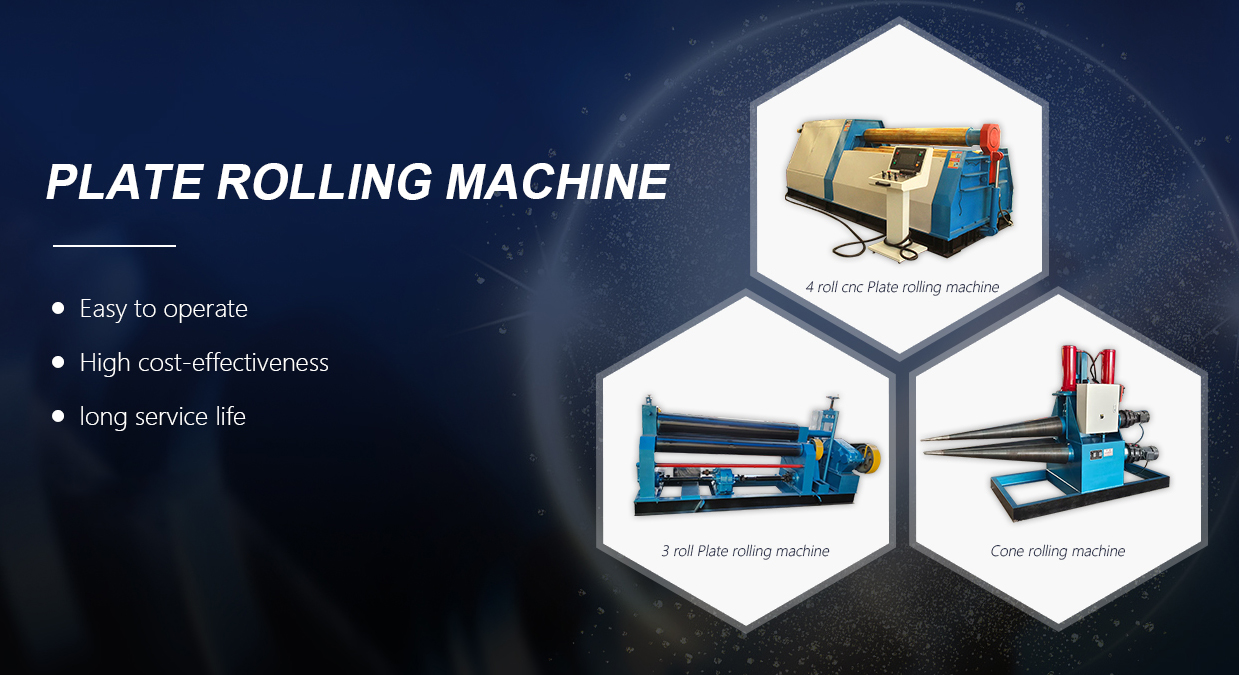
In the field of modern metal processing equipment, hydraulic plate rolling machines have become indispensable core machinery in manufacturing due to their powerful forming capabilities, stable power output, and intelligent control systems. Whether in pressure vessels, chemical equipment, wind turbine towers, shipbuilding, bridge engineering, or steel structure fabrication, these machines deliver efficient, precise, and reliable plate rolling solutions for enterprises.
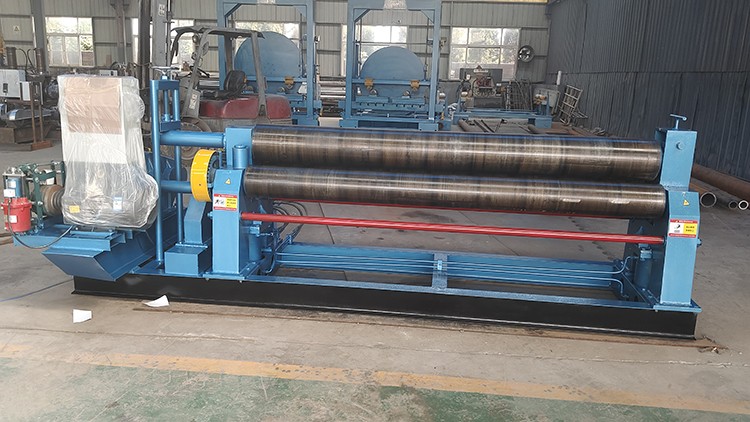
The most fundamental and critical function of hydraulic plate rolling machines is shaping flat steel plates into required circular, arcuate, or conical forms.
- Capable of rolling carbon steel, stainless steel, and alloy plates of varying thicknesses;
- Suitable for manufacturing cylinders, storage tanks, boiler shells, pressure vessels, etc.;
- High rolling precision with strong consistency in plate roundness.
Leveraging the hydraulic system's stable output pressure, the equipment achieves continuous, smooth curvature transitions, significantly enhancing finished product quality.
Pre-bending serves as a key indicator of a plate rolling machine's performance. By applying pressure to the upper or side rollers via hydraulic cylinders, hydraulic plate rolling machines effectively eliminate the “straight edge zone” at both ends of the steel plate, enabling high-quality rolling. Its functional advantages include:
- Shorter straight edges enable more precise closure at cylinder ends;
- Reduced weld gaps facilitate subsequent welding;
- Higher roundness and more uniform shape of finished products.
Thus, hydraulic roll forming machines are particularly suited for industries demanding high product precision.
After rolling completion, hydraulic roll forming machines can perform roundness correction on cylinders to ensure geometric accuracy and consistency of finished products.
- Corrects deformation caused by sheet springback;
- Enhances cylinder roundness and structural stability;
- Optimizes subsequent manufacturing processes (welding, assembly, NDT).
The roundness correction function further elevates product quality and effectively reduces defect rates.
Hydraulic plate rolling machines achieve conical rolling by adjusting the left and right roller positions, proving invaluable in manufacturing the following products:
- Conical chimneys;
- Conical funnels;
- Conical transmission structures;
- Conical sections of wind turbine towers.
The hydraulic system ensures consistent taper angles and a smooth, reliable rolling process—a capability difficult to achieve with mechanical plate rolling machines.
For complex metal components like bridge guardrails and decorative steel structures, hydraulic plate rolling machines enable continuous multi-segment curvature rolling. Key features include:
- Achieving multiple radii on a single plate;
- Natural arc transitions without visible creases;
- CNC control for automated complex curve rolling.
This makes hydraulic plate rolling machines increasingly prevalent in modern construction and large structural fabrication.
The hydraulic system delivers significantly greater power than mechanical rollers, offering these advantages:
- Capable of rolling thick plates and large-sized sheets;
- Enables continuous, high-load rolling tasks;
- Provides more stable torque output, minimizing jamming or stalling.
Consequently, hydraulic plate rolling machines are particularly prevalent in heavy industry and high-strength steel plate processing.
Hydraulic roll benders achieve rapid forming speeds and precise positioning, significantly boosting production efficiency.
Intelligent controls minimize reliance on skilled operators, lowering training and operational expenses.
The pre-bending function substantially reduces straight edges, enabling tighter cylinder closures and minimizing welding repairs and material waste.
Hydraulic plate rolling machines handle everything from thin to thick plates, circular to conical shapes, and simple arcs to multi-curvature components.
Hydraulic systems incorporate multiple safety measures including overload protection, emergency shutdown, and displacement monitoring.
With its efficient forming capability, powerful output, and intelligent control technology, the hydraulic plate rolling machine plays an irreplaceable role in steel structure manufacturing, pressure vessel production, shipbuilding, and construction machinery. As global manufacturing upgrades and automation trends accelerate, hydraulic plate rolling machines will continue to be essential equipment for enhancing corporate competitiveness, leveraging their advantages of high precision, broad applicability, strong efficiency, and excellent stability.
 Address:Room 1202, Detaitang Building, No. 118 Huaguang Road, Zhangdian District, Zibo, Shandong
 WhatsApp:+8615653328535
 Wechat: +8615965331535
  E-mail:zs@sdsmachinery.com