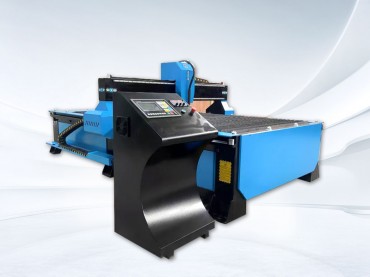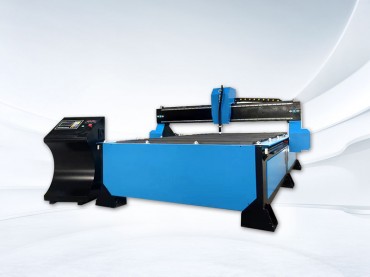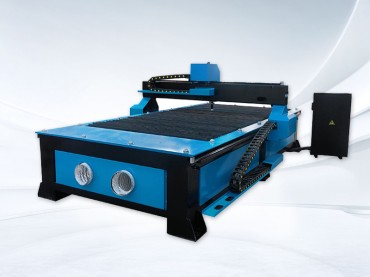
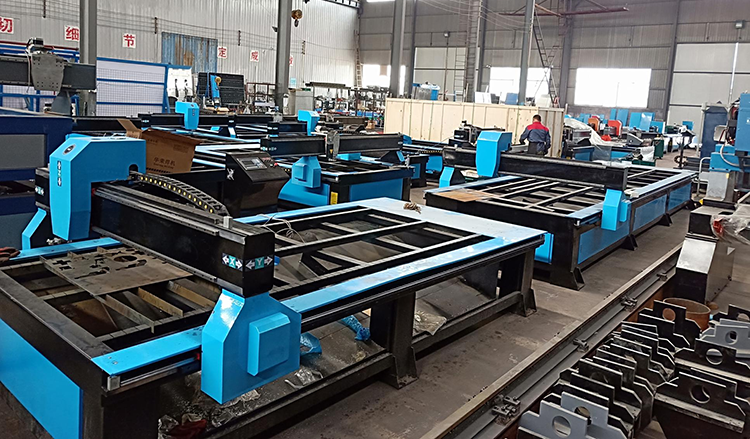
The commonly used gases for plasma cutting machines include nitrogen, oxygen, air, argon, and mixed gases of hydrogen and other gases. Different gases have different characteristics and are suitable for different cutting materials and requirements. The following will provide a detailed introduction to the application of various gases in plasma cutting machines.
Nitrogen is one of the commonly used working gases in plasma cutting machines. It has the characteristics of moderate ionization degree and endothermic decomposition (diatomic gas), which can effectively increase the arc column temperature, reaching about 30000 ℃. Nitrogen exhibits excellent performance when cutting materials such as stainless steel and aluminum alloys. When using nitrogen plasma arc to cut stainless steel, due to its high jet energy, even if cutting materials with high liquid metal viscosity, the amount of slag hanging on the lower edge of the cut is very small. At the same time, nitrogen has sufficient sources, low prices, and cost-effectiveness. However, the surface quality of nitrogen plasma cutting is relatively not ideal, so it is generally suitable for cutting stainless steel with low requirements for surface quality and not directly used for welding. In addition, nitrogen can be used alone or mixed with other gases. During automated cutting, nitrogen or air is often used as the working gas, which has become the standard gas for high-speed cutting of carbon steel.
Oxygen is mainly used in plasma cutting machines to increase the speed of cutting low-carbon steel materials. When using oxygen for cutting, the cutting mode is similar to flame cutting, and the high-temperature and high-energy plasma arc makes the cutting speed faster. However, it should be noted that when using oxygen cutting, high-temperature oxidation resistant electrodes must be used in conjunction, and the electrodes must be protected against impact during arc initiation to extend their lifespan. Because oxygen has strong oxidizing properties, it will undergo intense oxidation reactions with metals during the cutting process, generating a large amount of heat and accelerating the cutting speed. However, this oxidation reaction may also lead to severe oxidation of the incision surface, affecting the cutting quality, so it is usually suitable for cutting low carbon steel with low surface quality requirements.
The air contains approximately 78% nitrogen and 21% oxygen by volume, so the slag formation during air cutting is similar to that during nitrogen cutting. Meanwhile, due to the presence of oxygen, the speed of cutting low-carbon steel materials with air is also very high. And air is the most economical working gas, without the need for additional purchase and storage of special gases. But there are also some issues when using air cutting alone. For example, there may be problems such as slag hanging, oxidation of the cutting edge, and nitrogen addition, and the lifespan of the electrode and nozzle is relatively low, which can affect work efficiency and cutting costs. However, for some application scenarios that do not require high cutting quality and are cost sensitive, air plasma cutting machines are still a good choice.
Argon is an inert gas that hardly reacts with any metal at high temperatures, and the argon plasma arc is very stable. Moreover, when using argon gas, the nozzle and electrode have a longer service life. However, the voltage of argon plasma arc is lower, the enthalpy value is not high, and the cutting ability is limited. Compared with air cutting, its cutting thickness will be reduced by about 25%. In addition, in an argon protected environment, the surface tension of molten metal is relatively high, about 30% higher than in a nitrogen environment, so there will be more slag hanging problems. Even when using a mixture of argon and other gases for cutting, there may still be slag sticking issues. Therefore, argon gas is usually not used alone for plasma cutting, but is mixed with other gases to improve cutting performance.
Hydrogen is usually used as an auxiliary gas mixed with other gases. For example, the famous gas H35 (with a volume fraction of 35% hydrogen and the rest argon) is one of the gases with the strongest plasma arc cutting ability. This is mainly due to the significant increase in arc voltage by hydrogen gas, which gives the hydrogen plasma jet a high enthalpy value. When hydrogen is mixed with argon, the cutting ability of its plasma jet is greatly improved. For metal materials with a thickness of over 70mm, argon and hydrogen are commonly used as cutting gases. In addition, nitrogen hydrogen mixed gas is also commonly used in plasma cutting. The good heat carrying and thermal conductivity of hydrogen gas, as well as the high heat released during ionization particle recombination, can enhance the cutting effect.
 Address:Room 1202, Detaitang Building, No. 118 Huaguang Road, Zhangdian District, Zibo, Shandong
 WhatsApp:+8615653328535
 Wechat: +8615965331535
  E-mail:zs@sdsmachinery.com