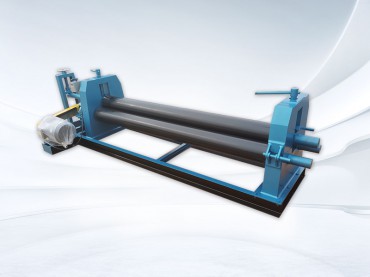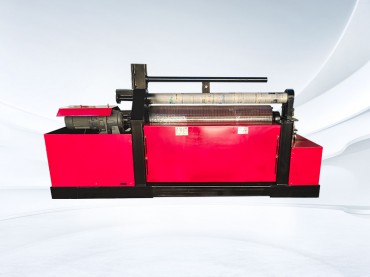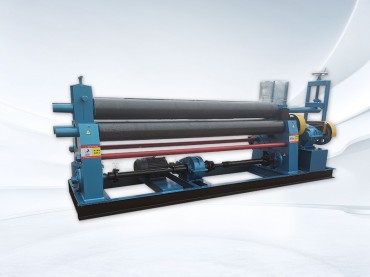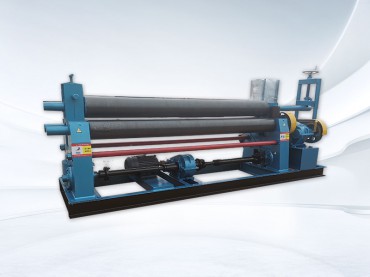
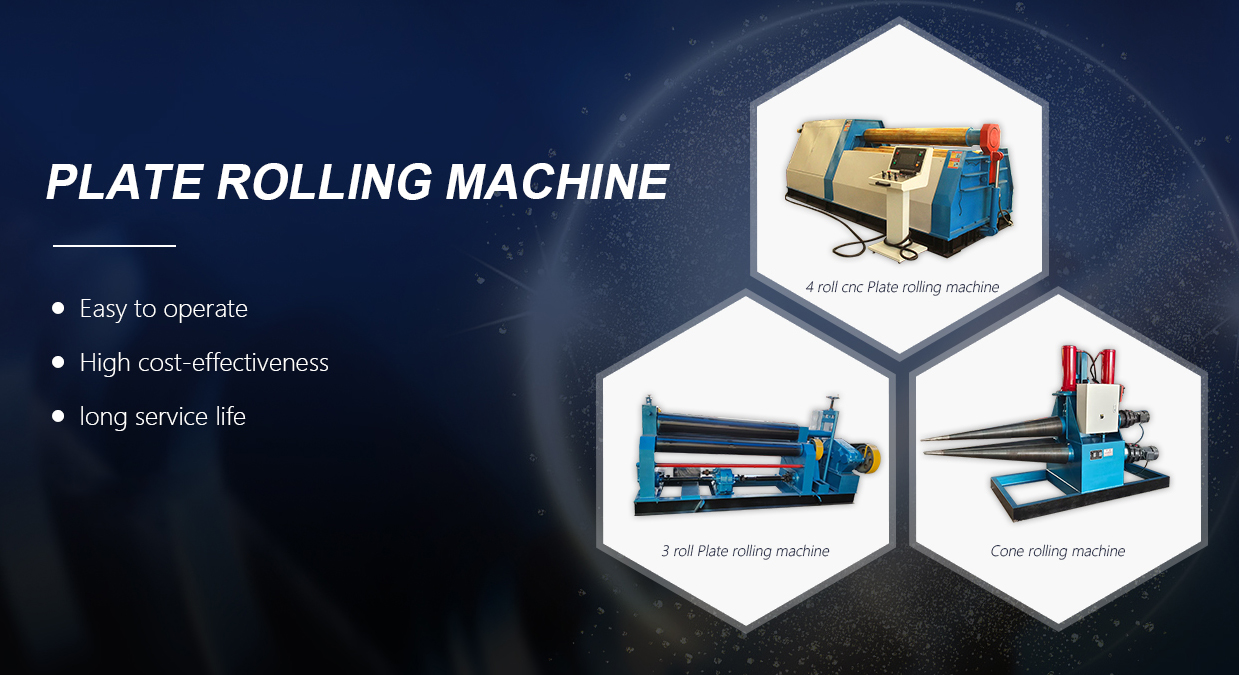
The four-roller plate bending machine primarily consists of four rollers. By rotating the rollers and adjusting pressure, it performs bending, straightening, and other processing operations on metal plates. Its working principle utilizes the friction between rollers to induce plastic deformation in the plate as it passes through, thereby achieving the desired processing effect.
(1) Workpiece Placement: Position the metal workpiece to be rolled at the machine's feed inlet.
(2) Upper Roller Pressing: The upper and lower rolls of the four-roller plate rolling machine form a pair of pressure rolls. Hydraulic or mechanical force presses the upper roll onto the lower roll, clamping the metal workpiece to be rolled.
(3) Front/Rear Roller Adjustment: The front and rear rolls control the feeding direction and bending radius of the metal workpiece. Adjusting these rolls achieves varying degrees of bending.
(4) Rotating Roller Movement: The two rotating rolls of the four-roller plate bending machine guide the metal workpiece along the bending direction of the upper and lower rolls, progressively shaping it into the desired form.
(5) Bending Completion: After multiple rolling passes and adjustments, the metal workpiece is formed into the required shape and then removed through the machine's discharge port.
(1) Preparation: Select and cut raw materials; clean and lubricate the four-roller bending machine.
(2) Feeding: Feed prepared raw materials into the machine's inlet.
(3) Pressing Down: Rollers press the material down through the feed opening, where it undergoes compression before entering the first rolling pass.
(4) Rebound: The metal material rebounds and enters the second rolling pass.
(5) Rolling: After the first and second passes, the metal material undergoes repeated rolling within the four-roller mill until the required specifications are achieved.
(6) Centering: During rolling, operators continuously monitor and adjust the material's rolling condition to ensure proper centering throughout the process.
(7) Discharge: The finished metal material is removed from the four-roller mill via the discharge device for subsequent processing or packaging/transportation.
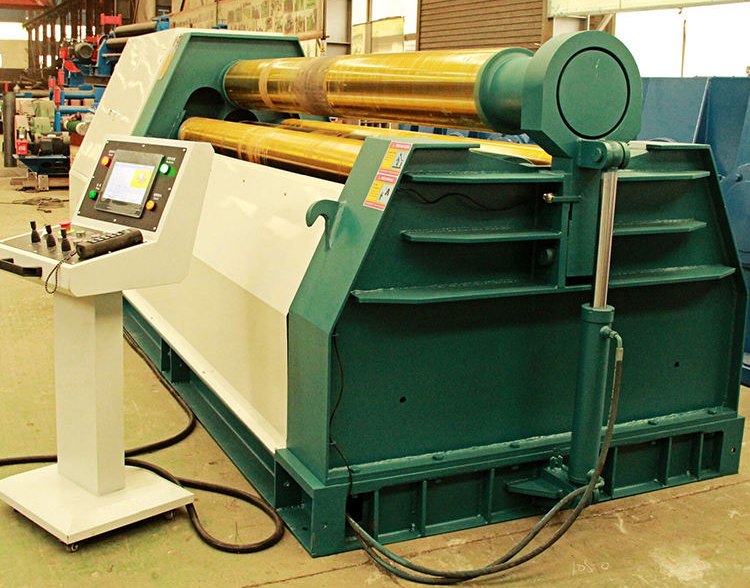
Equipped with an automatic plate clamping system, it ensures plates remain fully supported throughout the rolling process. Even novice operators can easily achieve precise pre-bending and tapered rolling.
Its pre-bending capability limits flat ends to within 1.5 times the plate thickness, delivering over twice the production efficiency of traditional three-roller plate bending machines.
Simultaneous force application across multiple rolls ensures uniform stress distribution and stable forming trajectories. Independent shaft design further improves rolling accuracy and consistency.
Simultaneous pre-bending and rolling eliminates intermediate handling or additional operations, reducing trimming waste and material loss. This minimizes errors and rework rates, resulting in lower overall costs.
The bottom and side rolls can tilt in coordination with rotating guide blocks (taper shoes), enabling precise forming of: cylinders, round tubes, variable-diameter pipes, semicircles, half-pipe structures, various conical shapes (different apex angles, eccentric cones), ellipses, and elliptical-to-circular transition structures.
Constructed from thick steel plates and high-quality components, the four-roller plate roller withstands heavy-duty workloads. Premium equipment (e.g., Longxu Heavy Industry) utilizes universal parts for global interchangeability and supports localized service.
It processes plates ranging from 2mm thin to 150mm thick, fully covering and surpassing the processing range of three-roller machines.
(1) Before operating the four-roller plate bending machine, thoroughly review the equipment manual to understand its performance parameters and operational requirements.
(2) Maintain full concentration during operation to prevent accidents.
(3) Perform regular maintenance on the four-roller plate bending machine to ensure long-term stable operation.
(4) In case of equipment malfunction or abnormal conditions, immediately stop the machine for inspection and promptly contact qualified personnel for repairs.
The production process flow of four-roller rolling mills significantly impacts production efficiency and product quality. Each step requires strict control and meticulous operation. Only through continuous optimization and refinement of the production process flow based on accumulated experience can enterprises achieve higher efficiency and quality assurance.
 Address:Room 1202, Detaitang Building, No. 118 Huaguang Road, Zhangdian District, Zibo, Shandong
 WhatsApp:+8615653328535
 Wechat: +8615965331535
  E-mail:zs@sdsmachinery.com