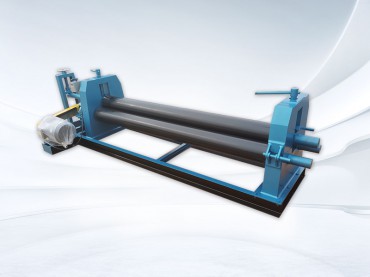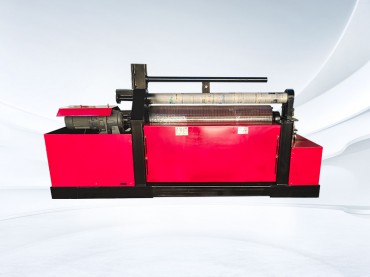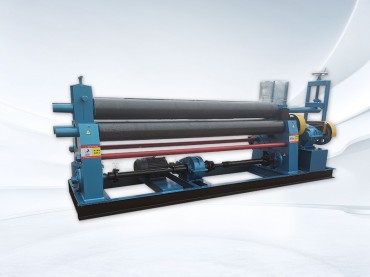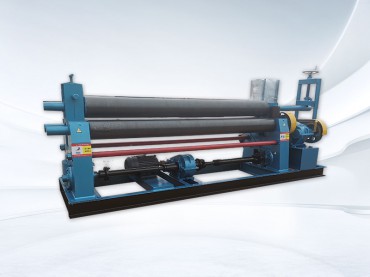
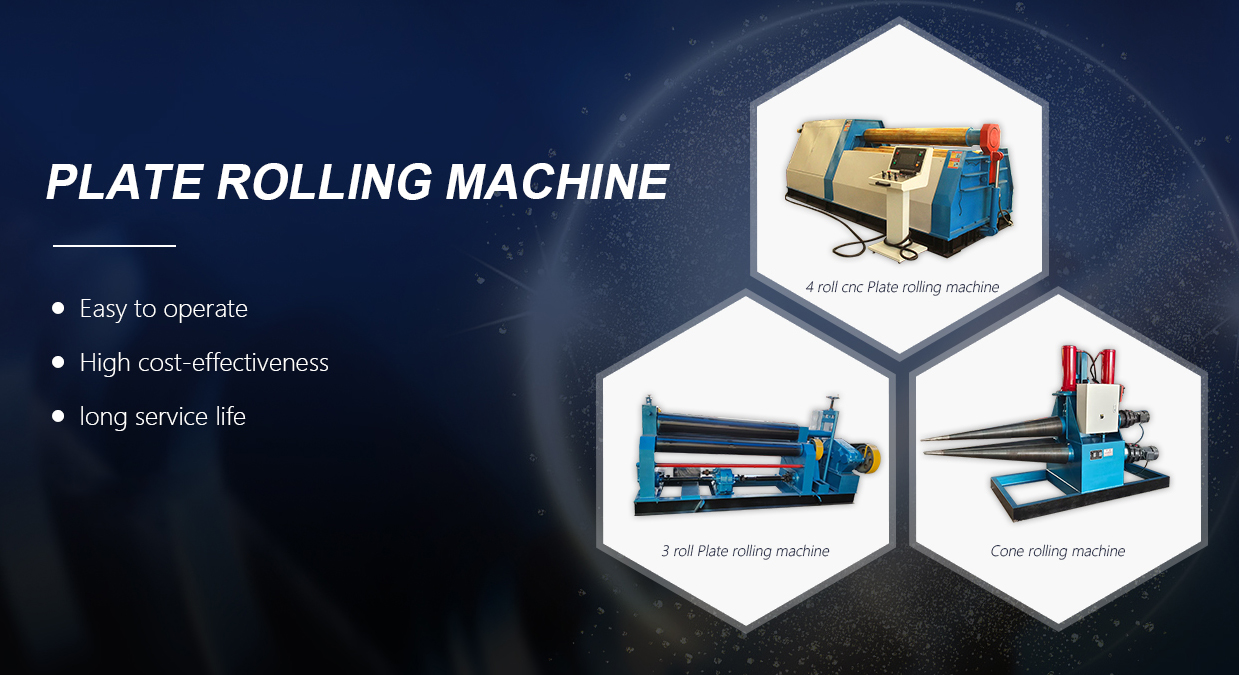
As an important piece of equipment in the metal processing industry, the plate rolling machine is widely used in the manufacture of pipes, storage tanks, pressure vessels, boilers, shipbuilding, and large steel structures. Its core function is to roll flat metal sheets into cylinders, arcs, or other required curved surfaces. In this process, scientific and reasonable calculation methods are key to ensuring the dimensional accuracy and forming quality of the product. This article will systematically introduce the calculation methods, operational points, and precautions for practical applications of plate rolling machines, providing a reference for readers.
First, the length of the metal sheet that needs to be rolled into a cylinder must be calculated. This calculation requires the following parameters: sheet width, rolling diameter, sheet thickness, and rolling angle. The formula for calculating the length of the rolled plate is as follows:
Rolled plate length = π × (D + Dc) / 2 × Cot(α / 2) + (L1 + L2)
Where D is the rolling diameter, i.e., the diameter of the circle we wish to roll; Dc is the bending radius, which should be slightly larger than D to prevent cracks during the pulling process; α is the rolling angle, representing the degree of bending of the sheet during rolling; L1 and L2 are the end chamfer lengths, typically 1–2 times the sheet width, with specific values determined based on actual conditions.
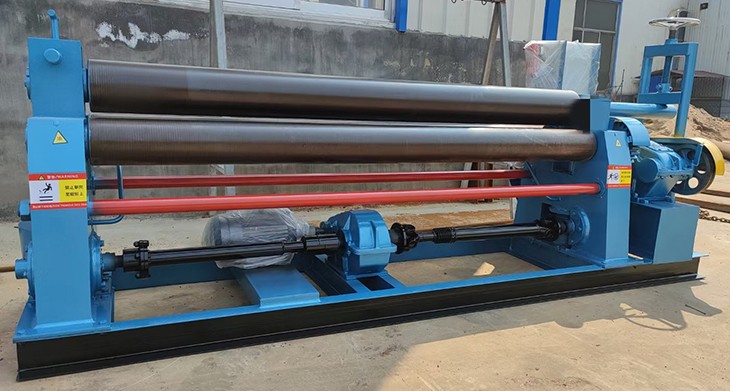
During the rolling process, three rollers are typically used to ensure the production of a perfect circle. To achieve this goal, the rollers must be adjusted appropriately.
The primary task is to ensure that the three rollers are at the same horizontal level, which can be achieved by checking their height differences and making fine adjustments using adjustment bolts. Additionally, the end rollers should be slightly adjusted up or down based on actual conditions. The primary task is to ensure that the three rollers are at the same horizontal level, which can be achieved by checking their height differences and making fine adjustments using adjustment bolts. Additionally, the end rollers may need to be slightly adjusted upward or downward based on actual conditions to ensure they closely follow the edges of the sheet during rolling, thereby improving rolling quality.
Determining the starting point is critical during the rolling process. The choice of starting position is influenced by the width of the metal sheet and the rolling diameter. For narrower sheets, rolling typically begins from the centre position; for wider sheets, the starting point must be selected on the left or right side. Additionally, the leading length—the portion of the sheet extending beyond the bottom—must be fully considered to ensure smooth processing of the weld seam.
Once all preparatory work is complete, rolling of the metal plate can begin. The first step is to position the starting point in front of the roll exit, then gradually move the plate backward while using the roll forming machine's automated control system for continuous rolling operations. During rolling, the rolling angle and force must be continuously monitored and adjusted to ensure the rolled circle meets quality requirements.
After rolling is complete, the rolled metal circle must be inspected. First, check the diameter for accuracy. Second, inspect the flatness and circularity of the circle, as well as the quality of the weld seam. If any non-conformities are found, corrections or re-rolling must be performed.
(1) Springback Phenomenon: After rolling, the metal plate may experience diameter enlargement due to elastic recovery. This can be prevented by calculating and compensating for the radius.
(2) Edge Curling: Typically caused by uneven rollers or insufficient clamping force. This can be resolved by increasing the pressure at the ends.
(3) Uneven forming: This may be related to uneven sheet thickness or unstable feeding. Strengthen sheet quality control.
(4) Cracks and fractures: These are often caused by an overly small bending radius. Increase the roller spacing or use a hot rolling process.
The calculation and operation of a rolling machine are not merely simple mechanical actions but a comprehensive process involving mathematical formulas, mechanical analysis, and precise control. Only by reasonably calculating the unfolded length, scientifically adjusting the roller positions, and strictly controlling the rolling parameters can cylindrical or arc-shaped components with accurate dimensions, reliable welding, and high quality be produced. For metal processing companies, mastering scientific rolling calculations not only improves production efficiency and product but also significantly reduces material waste and production costs.
 Address:Room 1202, Detaitang Building, No. 118 Huaguang Road, Zhangdian District, Zibo, Shandong
 WhatsApp:+8615653328535
 Wechat: +8615965331535
  E-mail:zs@sdsmachinery.com